
This article was previously published in the Hill Times.
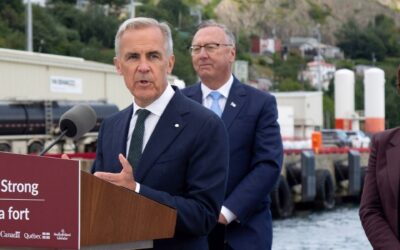
The recent Memorandum of Understanding (MOU) signed by Alberta Premier Daneille Smith and Prime Minister Mark Carney in Calgary risks fracturing the foundation of Canada’s entire approach to tackling climate change and narrowing the pathway to achieving climate goals.
The MOU was hailed as a “historic reset” of the relationship between Ottawa and energy-rich Alberta: it outlines the conditions by which the federal government would support a new bitumen pipeline to tidewater, and grants Alberta special treatment on a suite of federal policies. Those range from a province-specific suspension on the clean electricity regulations, to a promised but-to-be-determined equivalency agreement delaying tougher limits on methane pollution, and a pledge to adjust the tanker ban on the West Coast “if necessary” to enable bitumen export.
Other provinces, like Ontario, wasted no time getting in line to request their own special treatment.
Is this the start of the race to the bottom on Canadian climate policy?
We’ve seen this dynamic before: most recently, when the Trudeau government granted a carve-out removing the consumer carbon tax from home heating oil in response to political pressure from Atlantic Canada. Within short order, Alberta said it would sue the federal government for unfair treatment. Saskatchewan stopped collecting the carbon tax altogether.
That carve-out was the start of the unravelling for consumer carbon pricing. And it’s a textbook example of why minimum national standards, applied fairly across the country, are critical to the effective functioning of federal policies and regulations within the federation. Giving Alberta special treatment in this case invites copycat demands from other provinces and territories. The likely result is an erosion of national standards, greater economic fragmentation, and less coherent and effective policy overall.
That’s a problem in a world where Canada is working hard to reduce trade barriers, diversify its economy, and attract new investment. Policy certainty is among the deciding factors companies and investors take into account when making long-term investment decisions. When the rules of the game become negotiable on political grounds, it puts a chill on investment—because who’s to say the rules won’t change again a few years down the road when the political calculus or players change?
There is, however, one potentially major step forward amidst the maze of red flags in this MOU: namely, Alberta’s commitment to improve its industrial carbon pricing system, the Technology Innovation and Emissions Reduction Regulation (TIER). This system covers roughly 25 per cent of Canada’s total greenhouse gas emissions, so modernizing TIER is one of the most important and cost-effective steps Alberta can take to reduce emissions.
The MOU includes commitments for Alberta and the federal government to collaborate on developing “globally competitive, long-term” carbon prices, revenue recycling protocols and sector-specific stringency for large emitters, while promising to “ramp up to a minimum effective credit price of $130 per tonne”—though without locking in a specific timeline for doing so.
Whether these changes live up to their potential will be contingent on the details that will be worked out in the coming months (mark your calendars for April Fools’ Day, 2026, the agreed-upon date for these details to be finalized).
Modernizing TIER would increase and stabilize incentives for reducing emissions and investing in low-carbon projects, and establish a precedent for carbon market transparency. Unfortunately, by framing these elements as part of a negotiated deal with Alberta, the MOU undermines the credibility of the federal industrial carbon pricing benchmark and backstop as an objective, consistent minimum standard across all provinces, a principle the Supreme Court has explicitly recognized as central to effective national carbon pricing.
That’s why, in parallel to working out the details on these changes with Alberta, the federal government should move quickly to fix the federal benchmark that defines minimum standards for all provincial systems, strengthen the federal backstop, apply it decisively in jurisdictions that do not meet the benchmark, and work with provinces to develop a long-term price trajectory and a nationally consistent price ‘floor’ for industrial emissions credits. These changes are essential to bring greater credibility and certainty to carbon markets both now and beyond 2030, so that businesses can make big investments in low-carbon projects.
Time will tell just how slippery a slope the Alberta-Canada MOU has carved into Canada’s climate policy landscape. But the outlook is clear: Canadian climate policy has now become the art of the deal, moving from rules-based policy to deal-based bargaining. To counteract that trend, the federal government should reinforce its role in setting clear, rules-based minimum standards. It should clearly define the terms for provincial equivalency for methane regulations. It should ensure that improvements to industrial carbon pricing, especially for electricity, can make up for any concessions on the Clean Electricity Regulation in Alberta and other provinces. And it should update the carbon pricing backstop to require all provinces to maintain a rising minimum carbon price.