

Key takeaways
- Nearly 20 per cent of Canada’s greenhouse gas emissions come from household energy use, which includes both residential heating and cooling and personal transport.
- The solution to cutting household emissions lies almost entirely in switching from fossil fuels to electricity with electric vehicles (EVs), heat pumps, and electric appliances—changes that come with upfront costs but can save people money over time.
- This is low-hanging fruit for policy-makers looking to cut emissions with changes Canadians want.
- For households, switching to EVs, electric appliances, and equipment is relatively straightforward—especially compared to hard-to-decarbonize industrial sectors.
- It comes down to making it easier and more affordable for people to use efficient electric technologies.
- Smart government policies can help make the transition smoother, faster, and more equitable.
Recent fuel price spikes underscore the benefits of clean electricity
Cascading global events have thrust fossil-fuel prices into the spotlight, with many analysts describing the current situation as the worst oil shock the world has seen since the 1970s.
For most Canadians, it has been impossible to ignore the sudden and sharp spikes in prices for gasoline and diesel to power their vehicles as well as home-heating oil. Electricity prices, meanwhile, have remained relatively stable.
The war in Iran and closure of the Strait of Hormuz have highlighted just how vulnerable the world is to fossil-fuel price spikes. But it’s not a new phenomenon: over the past 10 years, gasoline prices were more than three times more volatile than electricity prices, and furnace oil prices were 6.5 times more volatile.

At the same time, electric vehicles are getting cheaper, and more makes and models are available in Canada every year. Heat pumps are continuing to take off in the Maritimes while other parts of the country are adopting them more gradually. And induction stoves are replacing gas ranges in more and more homes.
Globally, uptake of electric consumer technologies is skyrocketing. Last year, one quarter of global vehicle sales were EVs. In China, EVs made up more than half of all sales. Heat pump sales are also increasingly commonplace. In Norway and Finland, they are already installed in most households. In the United States last year, the sale of heat pumps outpaced the sale of gas furnaces for the third year in a row. The costs of electric technologies, including batteries and rooftop solar, are falling and only expected to drop further.

New cost projections for clean energy technologies are one factor in the newest modelling of Canada’s net zero pathways. The Canadian Climate Institute released its report on Canada’s Net Zero Future five years ago and this past year we updated our modelling to reflect current realities. In the newest results, electrification is still the most practical and cost-effective path to put a massive dent in emissions from households—a path that can save Canadians money and insulate them from the wild swings we continue to experience in fossil-fuel costs.
Our latest modelling looks at what changes would happen across the economy if Canada meets its long-term climate goals in the lowest-cost way, with a focus on emissions from households, which includes residential buildings and personal transport. We ran multiple scenarios to cover a range of possible futures, varying the factors that we’ve learned have the biggest influence on the results: faster or slower pace of decarbonization and external drivers such as global oil price, the cost of clean technologies, and whether Canada decarbonizes alone or in step with the United States. The mid-range scenario referenced in several of the figures below assumes a slower pace of decarbonization, mid-range assumptions for cost of oil and cleantech, and parallel decarbonization efforts in the U.S. over the long term.
Running this breadth of scenarios shows us what patterns in the results are most robust across many possible futures, despite uncertainty in what will happen in the wider world and outside the influence of domestic policy.
And what’s clear from every modelled scenario is that household electrification is a safe bet climate solution that shows up in a big way. It’s a no-regrets solution based on existing technologies that are known to work but need to be scaled up.
That’s not to say achieving the levels of electrification outlined in our modelling is going to be easy—it will require the right mix of policy across all orders of government to make it a reality. But Canada cannot meet its climate targets without progress on household energy use and many households can’t make progress on their own.
The solution for households is electrification and energy efficiency
Currently, fossil fuels still dominate when it comes to passenger transportation, home heating and cooling, and appliances like water heaters and stoves. All told, fossil fuels account for roughly two-thirds of household energy use in Canada today—but that share has been trending downward.
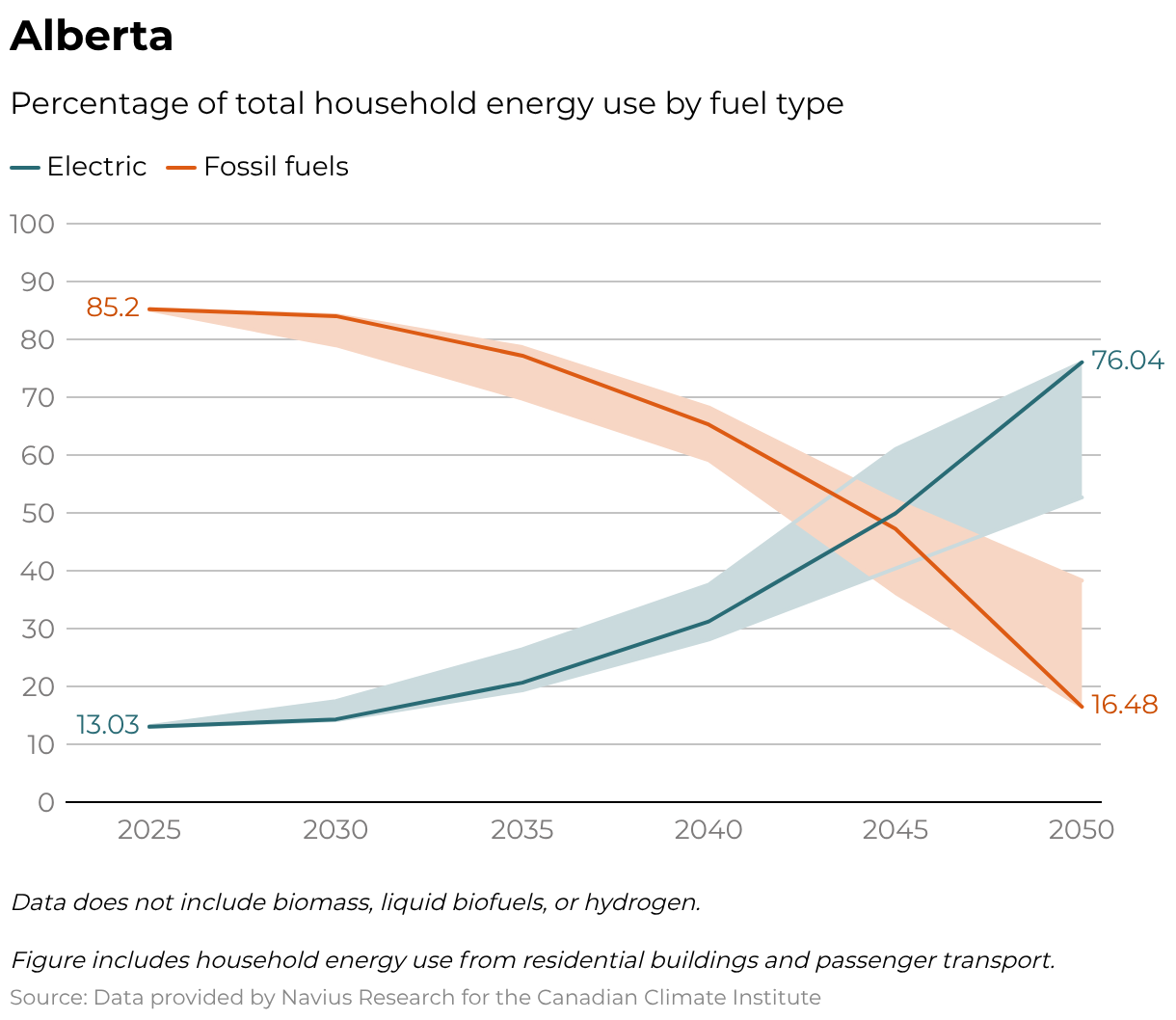
For Canada to cut its emissions to net zero by mid-century in the most cost-effective way, our modelling shows that electricity overtakes fossil fuels to meet the vast majority of household energy needs by 2050. This pattern is consistent across all scenarios and in all regions.

Today, electricity is already used to meet nearly half of energy needs for heating, cooling, and appliances in residential buildings in Canada. Looking to 2050 in the modelling results, on the most cost-effective path to net zero emissions, that share rises quickly over time: by 2050, between 73 and 91 per cent of residential heating load is met by electricity.
There is some regional variation:
- In the Maritimes, where heating oil and gas prices are relatively high, heat pumps save most households money. Policy in these provinces has already accelerated the shift towards electric heating (and cooling). From 2017 to 2023, the proportion of homes using heat pumps in Nova Scotia more than doubled. In New Brunswick, it nearly tripled. And in Prince Edward Island, it quadrupled.
- In the Prairie provinces, where natural gas heating is more common and less expensive, the household economics look different. Sticking with gas remains a lower-cost option than converting to electric heat for some households in the current policy environment, even if household electrification is the most cost-effective decarbonization solution for the overall provincial economy.
- In other places, where electricity already dominates the heating mix, such as Quebec and Newfoundland and Labrador, the big benefits come from energy efficiency of new electric technologies and better buildings. The performance improvements of heat pumps compared to electric baseboards, for example, can cut household energy use for heat by up to a third.
The speed and extent of household electrification will vary across Canada, but the overall direction is consistent

For passenger transportation, the pattern of electrification is even stronger—and less sensitive to regional variation.
Nationwide, the modelling results show that to meet net zero, uptake of battery electric and plug-in hybrid vehicles grows to more than 96 per cent of total vehicle kilometers travelled by 2050. That compares to approximately 4 per cent today. This modelling trajectory is highly consistent across all the scenarios, and in all provinces and territories. While provinces and territories differ in how many EVs were on the road starting in 2025, the direction of future travel is similar.
EVs and plug-in hybrids overtake fossil-fuel vehicles on the road to net zero, regardless of province


Overall, the modelling shows an upward trajectory for electrification in residential buildings and personal transport in every province and territory—even in jurisdictions such as Alberta and Saskatchewan, which currently rely much less on electricity. When factoring in all household energy uses, Quebec has the highest level of electrification today and is projected to be the most electrified by 2050.

The starting point and speed of each provincial and territorial transition to electricity is in part due to differences in their policy mix and energy prices. Switching from a gasoline or diesel passenger vehicle to an EV consistently offers cost savings on a lifetime basis in nearly every context in Canada. But, to date, the strongest EV uptake has happened in B.C. and Quebec, which have had the strongest policies alongside low electricity rates.
From the modelling analysis, the pattern is consistent: to reduce Canada’s emissions in the most inexpensive way, most household energy use must be electrified. Still, beneath the big trends are 16.8 million individual households and the complex network of electricity infrastructure that serves them. In the project of household electrification, the relative simplicity of the technological solutions meets a great variety and complexity of household contexts—across different regions, as we see in our results, and also across housing types, income levels, and rural-urban-suburban divides.
Efficiency improvements boost the value of electrification
The trajectory of electrification is projected to happen alongside gains in household energy efficiency, meaning households will use less energy overall even as the population grows.
By 2050, the Canadian population is expected to increase by 19 per cent but, based on the mid-range scenario, household energy use is projected to be 26 per cent lower than it is today.
The result would be a 38 per cent reduction in energy use, per person, compared to 2025.

Electric technologies waste less energy compared to their fossil fuel-powered counterparts.
Broader energy efficiency improvements, such as tighter building envelopes, compound the efficiency gains.
This is a one-two punch for emissions reductions and household savings on energy costs. With better insulated homes and more efficient electric appliances operating inside their homes, Canadians will waste far less precious energy, reducing the relative need for generation at the grid level and cutting their monthly power bills at the same time—and, all the while, reducing reliance on fossil fuels and their price volatility.
And none of this requires new kinds of technology or innovation.
Electric vehicles are already two to four times more efficient than internal combustion engines (ICE); they operate at 80 to 90 per cent efficiency compared to 25 for 40 per cent for internal combustion engine vehicles.
Heat pumps produce heating at two to five times the efficiency of gas furnaces. Even compared to other electric options, heat pumps are about three times more efficient than electric resistance heating.
The projections are an acceleration of existing trends: Canadian households have become more efficient over the past few decades. In residential buildings between 2000 and 2022, the energy required for space and water heating, appliances, lighting, and space cooling per household decreased by 20 per cent, driven by better-insulated buildings and more efficient household equipment. Similarly, between 2005 and 2019, fleet-wide vehicle efficiency improved by 15 per cent, driven in part by fuel economy regulations.
Deeper energy savings, thus, present an opportunity for sustained cost savings for households.
But switching out your furnace or gasoline vehicle for an electric alternative isn’t an easy thing for many Canadians—even if it means saving money in the long run. Upfront costs can be a barrier. In some regions in Canada, electric technologies are difficult to access and lack experienced salespeople and installers.
Electric technologies also depend on reliable electricity infrastructure that’s ready to meet demand.
This is where dependable policy supports are crucial.
Policy turns potential into payoff—in energy savings and emissions cuts
The world is electrifying rapidly and Canada should not be caught unprepared. Even absent policy change, this global wave will eventually reach Canada’s shores.
That’s good news. The movement towards electric technologies and away from fossil fuels brings lasting emission reductions alongside other benefits to Canadian households. Heat pumps can provide efficient cooling, protecting more households against the dangers of extreme heat. Electric induction stoves offer better indoor air quality compared to gas and a better cooking performance.
New detailed energy wallet analysis by Clean Energy Canada found that in most places in Canada, switching to clean electricity would save households money in the long term. Electric vehicles are the greatest driver of cost savings. In some regions, such as the Prairies, heating with gas is still cheaper than doing so with electricity under status quo policies. In other regions, such as B.C., heat pumps produce heating at a lower cost than gas, and heat pumps consistently offer savings compared to fuel oil Canada-wide.
Over the long-term, electricity also offers more stable and predictable energy costs. Electricity is already less vulnerable to volatility in price than other energy sources—in particular compared to oil, as we’ve seen recently. Energy efficiency, as both a feature of electric technologies and a complementary measure, further insulates households from rising energy costs.

Electrification and efficiency improvements are starting to reach Canadian households. Emissions from passenger transport and residential buildings are starting to trend down, due in large part to the impact of current and planned policy. But bending the emissions curve downward demands renewed policy effort.

There are two ways that governments can accelerate the shift to energy-efficient, emission-cutting electric technologies:
- Boost consumer uptake of electric technologies and efficiency.
- Prepare our energy and infrastructure systems to support greater electricity demand.
To boost uptake, policy can make access to electric technologies easier, more affordable, and fairer for Canadian households. That can mean making electric technologies and efficiency the default in new homes, and requiring EV-readiness for multi-unit buildings. Policy measures that make a wider variety of EVs more available—such as forthcoming vehicle emissions standards and the recent decision to allow for sale a small number of Chinese EVs—also make it easier for consumers to choose them. Low-cost financing and direct subsidies for consumers, especially for lower-income households, also make a difference. Policy support for households can also reach more Canadians by designing measures that include those who rent, use car shares, and take public transit.
To prepare our energy and infrastructure systems, policy change can help drive further investment and innovation in a clean and reliable electricity system that keeps pace with burgeoning demand.
That means a substantial build-out of new, clean sources of electricity, more energy storage, and upgraded transmission systems. To meet net zero across the whole economy, electricity generation will need to double or triple by 2050 compared to today.
In residential areas, widespread electrification also requires investment in electricity distribution systems and wider use of new solutions—like demand flexibility—to integrate more demand at lower costs.
EVs also need a dependable fast-charging network, particularly on major highway corridors, to support growing uptake.
Policymakers across Canada face a common challenge: to galvanize big investments and modernization of electricity infrastructure while maintaining the stability and cost-competitiveness of electricity rates.
In most of Canada, electricity has been a safe haven from fossil fuel volatility. Maintaining electricity’s stability advantage and keeping rates affordable through a period of massive growth is not automatic. It will depend on deft policy. In Canada, electricity investments and consumer rates are tightly regulated, casting policymakers in a particularly central role.
This moment may be full of uncertainty when it comes to oil prices, the broader economy, and the geopolitical order, but it also offers the opportunity to make a safe bet on proven technologies that many Canadians are already welcoming into their homes. For others, all they need is a nudge.
Globally, an electric future is coming. Policy that invests now in households—and the infrastructure they depend on—can help prepare Canadian communities to meet that future.