
Climate change, primarily from the burning of fossil fuels, is causing more frequent and intense heat waves (Giguere et. al 2025). These heat waves are threatening the safety, well-being, and prosperity of Canadians—even in cities that have historically had more moderate climates, such as Vancouver, Whitehorse, and Halifax.
Globally, 2025 was one of the hottest years on record, while the past eleven years have been the eleven warmest on record (World Meteorological Organization 2026). Canada, which is warming faster than anywhere else on earth, is suffering the consequences of the overheating climate (McBean 2024). In 2025 record-shattering spring and summer temperatures spanned New Brunswick, British Columbia, the Yukon, the Northwest Territories, every Prairie province, and Northwestern Ontario, fueling the country’s second-worst wildfire season on record (Environment and Climate Change Canada 2025).
Climate change fuels heat waves
- Climate change increases the frequency of extreme heat, and makes heat waves hotter, longer, and more widespread (Borenstein 2024; Rantanen 2024; Skinner et. al 2025).
- Canada is warming twice as fast as the global average, and Canada’s Arctic is warming nearly four times as fast (Government of Canada 2019; Rantanen et al. 2022).
- Climate projections show that by the second half of this century, many Canadian cities will see two to four times as many +30°C days per year on average compared to historical data (Climate Atlas of Canada n.d.).
- Climate change is increasingly stalling weather patterns and making long-lasting “heat domes” nearly three times more common today than in the 1950s (Li et. al 2025). A heat dome occurs when a persistent high-pressure weather system traps hot air over a region like a lid. This phenomenon triggered the deadly 2021 British Columbia heat wave.
- In 2025, Canada experienced 12 extreme heat events, each made 2 to 10 times more likely due to climate change (Tamminga 2025).
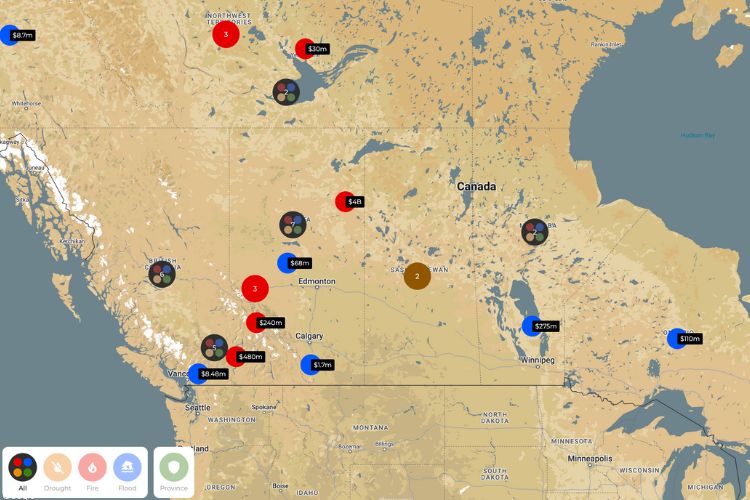
Explore the climate costs tracker to visualize climate-fuelled weather events in Canada.
Climate-fuelled heat makes wildfires worse
- During Canada’s worst wildfire season on record, in 2023, climate change more than doubled the likelihood of extreme fire weather conditions (high temperatures, low humidity, and drought conditions) in Eastern Canada, and made Québec’s season 50 per cent more intense (World Weather Attribution 2023).
- Heat waves make it easier for wildfires to start and spread by increasing the likelihood of lightning strikes, the primary cause of wildfires (Pérez-Invernón et al. 2023). They also dry out vegetation, making it more flammable (Natural Resources Canada 2024).
- During the 2021 heat wave in B.C., the number of active wildfires rose from six to 175, consuming nearly 79,000 hectares, including the entire town of Lytton (White et al. 2023).
- For more information on climate change and wildfires, see our wildfires fact sheet.
Climate-fuelled extreme heat is causing rising death rates and health issues across Canada
- Climate change has already expanded the reach of extreme heat. More than one third of the global population now lives in areas where heat severely limits safe physical activity (Parsons et. al 2026). In North America, extreme heat stress – the threshold where urgent action is needed to avoid severe health impacts – has doubled in frequency since the 1970s (Emerton et. al 2026).
- A study in Nature found that between 1981 and 2018, 37 per cent of heat-related deaths globally were attributable to climate change (Vicedo-Cabrera et al. 2021). This increased mortality is evident on every continent.
- Health risks from extreme heat include cardiovascular events, respiratory conditions, kidney disease, adverse pregnancy outcomes, and mental health impacts such as increased anxiety, depression, and aggressive behavior (Bell et. al 2024; Kwak et. al 2026; Neven & Quispel 2025).
- Prolonged high temperatures are linked to long-term health consequences. Repeated exposure to heat waves causes physical stress which speeds up the aging process, at a rate comparable to smoking (Chen et. al 2025; Kreier 2025).
- Climate change is worsening the frequency and intensity of extreme humid heat events, which increase the risk of heat illness, hospitalization, and death (Trudeau et. al 2026). High humidity prevents sweat from evaporating, which makes it harder for the body to cool itself down.
- Elevated death rates have been documented during and following heat waves in Canada (Government of Canada 2024). The 2021 heat wave caused an estimated 619 heat-related deaths, making it the deadliest disaster in B.C.’s recorded history (BC Coroners Service 2022).
- Our research shows that without action on adaptation and health system preparation, B.C. could average 2,200 heat-related deaths per year by 2050 (Beugin et al. 2023).
- Scientists found that the 2021 B.C. heat wave would have been virtually impossible without human-caused climate change (Philip et al. 2022).
- A 2024 study concluded that elevated summer temperatures in Québec are linked to 470 deaths, 225 hospitalizations, 36,000 emergency room visits, 7,200 ambulance transports, and 15,000 calls to Info-Santé every year (Boudreault et al. 2024). With climate change, the number of heat-related illnesses and deaths could double in the province by 2050 (Boudreault et al. 2025).
The economic burden of climate-fuelled extreme heat is growing
- The Canadian Climate Institute’s 2021 report The Health Costs of Climate Change projected that the costs of heat-related deaths and reduced quality of life from extreme heat in Canada would reach $3 billion per year by mid-century (Clark et al. 2021).
- Our analysis shows that the 2021 heat wave in B.C. caused $12 million in additional healthcare costs, and that the societal costs from premature deaths were $5.5 billion (Beugin et al., 2023).
- Canada’s manufacturing sector alone could see annual losses of $1-2 billion by 2050, due to the productivity impacts of heat waves on the workforce (Clark et al. 2021).
- Without adaptation, climate change-related damage from heat and rainfall will cost an additional $9.8 billion per year on average for roads, bridges, tunnels, and public transit between 2025 and 2100, according to our 2026 report Prepare or Repair: How climate-proofing public infrastructure pays off (Ness et. al 2026). Climate-related damage to electricity infrastructure, driven primarily by heat, could increase by $1.8 billion (Ness et al., 2021).
Governments can act to protect communities and slow further warming
- Scientists have warned that the consequences of climate change will only get worse as the concentration of heat-trapping gases in the atmosphere increases (IPCC 2022).
- Governments must act immediately to reduce greenhouse gas emissions and limit global warming, while adapting and preparing for the health and safety risks from extreme heat.
- Adaptation strategies can improve outcomes for the most vulnerable populations, including the elderly, children, people with chronic illness, and socioeconomically disadvantaged groups (Health Canada 2011).
- Effective adaptation strategies include:
- Installing indoor cooling devices like heat pumps or air conditioning, and planting green roofs and trees for shade. Our analysis shows these could reduce heat-related deaths and hospitalization 12 per cent and 7 per cent, respectively, in B.C. by the 2030s (Beugin et al. 2023).
- Providing employers and the public with information on how to stay safe during extreme heat waves.
- Sending early heat warnings to allow people, communities and responders to prepare.
- Designing infrastructure to withstand extreme heat and rainfall, potentially reducing damage costs by 80 per cent by the end of the century, or up to $3.1 billion each year (Ness et al. 2021).
- Regulating maximum indoor temperatures in rental housing to protect tenants from extreme heat (Lawton 2025). adaptation strategies include:
- Installing indoor cooling devices like heat pumps or air conditioning, and planting green roofs and trees for shade. Our analysis shows these could reduce heat-related deaths and hospitalization 12 per cent and 7 per cent, respectively, in B.C. by the 2030s (Beugin et al. 2023).
- Providing employers and the public with information on how to stay safe during extreme heat waves.
- Sending early heat warnings to allow people, communities and responders to prepare.
- Designing infrastructure to withstand extreme heat and rainfall, potentially reducing damage costs by 80 per cent by the end of the century, or up to $3.1 billion each year (Ness et al. 2021).
- Regulating maximum indoor temperatures in rental housing to protect tenants from extreme heat (Lawton 2025).
Resources
- Reporting Extreme Weather and Climate Change: A Guide for Journalists (Clarke and Otto 2024)
- Extreme Heat (World Meteorological Organization, 2026)
- Extreme Heat Events Overview (Government of Canada 2024)
- Extreme Heat Preparedness Guide (PreparedBC 2024)
- Health Impacts of Extreme Heat (Climate Atlas of Canada 2024)
Experts available for comment and background information on this topic:
- Ryan Ness is Director of Adaptation research at the Canadian Climate Institute and the lead researcher on the Institute’s Cost of Climate Change series. Ryan est également disponible pour des entretiens en français (Eastern Time, English and French).
For more information or to arrange an interview, please contact:
Claudine Brulé
Lead, Communications and External Relations
cbrule@climateinstitute.ca
(514) 358-8525
Krystal Northey
Lead, Public Affairs
knorthey@climateinstitute.ca
(514) 358-8525
References
BC Coroners Service. 2022. Extreme Heat and Human Mortality: A Review of Heat-Related Deaths in B.C. in Summer 2021. June 7. https://www2.gov.bc.ca/assets/gov/birth-adoption-death-marriage-and-divorce/deaths/coroners-service/death-review-panel/extreme_heat_death_review_panel_report.pdf
Bell, Michelle L., Antonio Gasparrini, and Georges C. Benjamin. 2024. “Climate Change, Extreme Heat, and Health” eds. Caren G. Solomon and Renee N. Salas. New England Journal of Medicine 390(19): 1793–1801. doi:10.1056/NEJMra2210769.
Beugin, Dale, Dylan Clark, Sarah Miller, Ryan Ness, Ricardo Pelai, and Janna Wale. 2023. The case for adapting to extreme heat: Costs of the 2021 B.C. heat wave. Canadian Climate Institute. https://climateinstitute.ca/reports/extreme-heat-in-canada/
Borenstein, Seth. 2024. “Study says since 1979 climate change has made heat waves last longer, spike hotter, hurt more people.” Associated Press, March 29. https://apnews.com/article/heat-wave-climate-change-worsen-hotter-797aae046df8165f5f8be7d3f40a8b74
Boudreault, Jérémie, Éric Lavigne, Céline Campagna, and Fateh Chebana. 2024. “Estimating the heat-related mortality and morbidity burden in the province of Quebec, Canada.” Environmental Research, September 14. https://doi.org/10.1016/j.envres.2024.119347
Boudreault, Jérémie, Céline Campagna, Éric Lavigne, and Fateh Chebana. 2025. “Projecting the Overall Heat-Related Health Burden and Associated Economic Costs in a Climate Change Context in Quebec, Canada.” Science of The Total Environment 958: 178022. doi:10.1016/j.scitotenv.2024.178022.
Bratu, Andreea, Kiffer G. Card, Kalysha Closson, Niloufar Aran, Carly Marshall, Susan Clayton, Maya K. Gislason, Hasina Samji, Gina Martin, Melissa Lem, Carmen H. Logie, Tim K. Takaro, and Robert S. Hogg. 2022. “The 2021 Western North American heat dome increased climate change anxiety among British Columbians: Results from a natural experiment.” The Journal of Climate Change and Health, May. https://www.sciencedirect.com/science/article/pii/S2667278222000050
Canadian Press. 2026. “Scorching Weather Results in 21 B.C. Communities Breaking Maximum Temperature Records.” CBC News, June 24. https://www.cbc.ca/news/canada/british-columbia/bc-heat-weather-records-fall-9.7247997 (accessed June 30, 2026).
Chen, Siyi, Yufei Liu, Yuanyuan Yi, Yiling Zheng, Jun Yang, Tiantian Li, Ta-Chien Chan, et al. 2025. “Long-Term Impacts of Heatwaves on Accelerated Ageing.” Nature Climate Change 15(9): 1000–1007. doi:10.1038/s41558-025-02407-w.
Clark, Dylan, Ryan Ness, Dena Coffman, and Dale Beugin. 2021. The Health Costs of Climate Change: How Canada Can Adapt, Prepare, and Save Lives. Canadian Climate Institute. https://climateinstitute.ca/reports/the-health-costs-of-climate-change/
Clarke, Ben, and Friederike Otto. 2024. “Reporting extreme weather and climate change: A guide of journalists.” World Weather Attribution. https://www.worldweatherattribution.org/reporting-extreme-weather-and-climate-change-a-guide-for-journalists/
Climate Atlas of Canada. (n.d.) Urban Heat Island Effect. Prairie Climate Centre. https://climateatlas.ca/urban-heat-island-effect
Climate Atlas of Canada. 2024. “Heath impacts of extreme heat.” https://climateatlas.ca/health-impacts-extreme-heat
Communicating the Health Risks of Extreme Heat Events: Toolkit for Public Health and Emergency Management Officials. 2011. Ottawa, Ontario: Health Canada. https://www.canada.ca/en/health-canada/services/environmental-workplace-health/reports-publications/climate-change-health/communicating-health-risks-extreme-heat-events-toolkit-public-health-emergency-management-officials-health-canada-2011.html
Emerton, Rebecca, Julien Nicolas, Anna Lombardi, and Claudia Di Napoli. 2026. “Global Heat Stress Intensification and Its Expanding Footprint on the Human Population.” Nature Climate Change. doi:10.1038/s41558-026-02670-5.
Environment and Climate Change Canada. 2025. “Canada’s Top 10 Weather Stories of 2025.” Government of Canada, December 18. https://www.canada.ca/en/environment-climate-change/services/top-ten-weather-stories/2025.html.
Giguere, Otto, Tannenbaum, Vahlberg, et al. (2025). Climate Change and the Escalation of Global Extreme Heat: Assessing and Addressing the Risks. Climate Central, Red Cross Red Crescent Climate Centre, World Weather Attribution. https://www.climatecentral.org/report/climate-change-and-the-escalation-of-global-extreme-heat-2025
Government of Canada. 2019. “Canada’s climate is warming twice as fast as global average.” Press release. April 2. https://www.canada.ca/en/environment-climate-change/news/2019/04/canadas-climate-is-warming-twice-as-fast-as-global-average.html
Government of Canada. 2024. “Extreme heat events: Overview.” May 7. https://www.canada.ca/en/health-canada/services/climate-change-health/extreme-heat.html
Henderson, Sarah B., Kathleen E. McLean, Michael J. Lee, and Tom Kosatsky. 2021. “Extreme heat events are public health emergencies.” BC Medical Journal, November.
International Labour Organization. 2024. Ensuring safety and health at work in a changing climate. April 22. https://www.ilo.org/publications/ensuring-safety-and-health-work-changing-climate
IPCC, 2022. Climate Change 2022: Impacts, Adaptation, and Vulnerability. Contribution of Working Group II to the Sixth Assessment Report of the Intergovernmental Panel on Climate Change Cambridge University Press. https://dx.doi.org/10.1017/9781009325844
Kirchmeier-Young, Megan, N. P. Gillett, F. W. Zwiers, A. J. Cannon, and F. S. Anslow. 2019. “Attribution of the influence of human-induced climate change on an extreme fire season.” Earth’s Future, January. https://doi.org/10.1029/2018EF001050
Kreier, Freda. 2025. “Repeated Heat Waves Can Age You as Much as Smoking or Drinking.” Scientific American, August 26. https://www.scientificamerican.com/article/repeated-heat-waves-can-age-you-as-much-as-smoking-or-drinking/
Kwak, Aneta, Dale Pendleton, and Chien-Ching Li. 2026. “Mental Health Impacts of Extreme Heat Exposure in the United States: Results from a State-Level Analysis.” Journal of Psychiatric Research 193: 447–50. doi:10.1016/j.jpsychires.2025.12.015.
Lawton, Betsy. 2025. “Home Cooling Policies Can Combat Health Impacts of Extreme Heat, But Should Be Paired with Strategies to Reduce Unintended Consequences.” https://www.networkforphl.org/news-insights/home-cooling-policies-can-combat-health-impacts-of-extreme-heat-but-should-be-paired-with-strategies-to-reduce-unintended-consequences/.
MacKinnon, Bobbi-Jean. 2025. “New Brunswick Heat Wave Breaks Long-Standing Records.” CBC News, August 12. https://www.cbc.ca/news/canada/new-brunswick/heat-new-brunswick-record-temperatures-1.7606725 (accessed June 30, 2026).
McBean, Gordon. 2024. “2023 was the hottest year in history — and Canada is warming faster than anywhere else on earth.” The Conversation, January 11. https://theconversation.com/2023-was-the-hottest-year-in-history-and-canada-is-warming-faster-than-anywhere-else-on-earth-220997
Natural Resources Canada. 2024a. “Canada’s record-breaking wildfires in 2023: A fiery wake-up call.” May 21. https://natural-resources.canada.ca/simply-science/canadas-record-breaking-wildfires-2023-fiery-wake-call/25303
Ness, Ryan, Dylan G. Clark, Julien Bourque, Dena Coffman, and Dale Beugin. 2021. Under Water: The Costs of Climate Change for Canada’s Infrastructure. Canadian Climate Institute. https://climateinstitute.ca/reports/under-water/
Ness, Ryan, Zacharie Carriere and Viviane Gauer. 2026. Prepare or Repair: How climate-proofing public infrastructure pays off. Canadian Climate Institute. https://climateinstitute.ca/reports/prepare-or-repair-canada-infrastructure/
Neven, J.C.G., and C. Quispel. 2026. “Extreme Heat and Pregnancy – A Growing Public Health Concern.” Case Reports in Women’s Health 49: e00762. doi:10.1016/j.crwh.2025.e00762.
Parisien, Marc-André, Quinn E. Barber, Mathieu L. Bourbonnais, Lori D. Daniels, Mike D. Flannigan, Robert W. Gray, Kira M. Hoffman, Piyush Jain, Scott L. Stephens, Steve W. Taylor, and Ellen Whitman. 2023. “Abrupt, climate-induced increase in wildfires in British Columbia since the mid-2000s.” Communications Earth & Environment, September 5. https://doi.org/10.1038/s43247-023-00977-1
Parsons, L A, J W Baldwin, G Guzman-Echavarria, O Jay, P Kalmus, H Staudmyer, J K Vanos, and N H Wolff. 2026. “Intensifying Global Heat Threatens Livability for Younger and Older Adults.” Environmental Research: Health 4(1): 015013. doi:10.1088/2752-5309/ae3c3a.
Pérez-Invernón, F.J., F.J. Gordillo-Vázquez, H. Huntrieser, et al. “Variation of lightning-ignited wildfire patterns under climate change.” Nature Communications 14, 739 (2023). https://doi.org/10.1038/s41467-023-36500-5
Philip, Sjoukje Y., Sarah F. Kew, Geert Jan van Oldenborgh, et al. 2022. “Rapid attribution analysis of the extraordinary heat wave on the Pacific coast of the US and Canada in June 2021.” Earth System Dynamics, December 8. https://esd.copernicus.org/articles/13/1689/2022/
PreparedBC. 2024. “Extreme heat preparedness guide.” Government of British Columbia. https://www2.gov.bc.ca/assets/gov/public-safety-and-emergency-services/emergency-preparedness-response-recovery/embc/preparedbc/preparedbc-guides/preparedbc_extreme_heat_guide.pdf
Rantanen, Mika, Alexey Yu. Karpechko, Antti Lipponen, et al. 2022. “The Arctic has warmed nearly four times faster than the globe since 1979.” Commun Earth Environ 3, 168. https://doi.org/10.1038/s43247-022-00498-3
Rantanen, Mika, Matti Kämäräinen, Miska Luoto, and Juha Aalto. 2024. “Manifold Increase in the Spatial Extent of Heatwaves in the Terrestrial Arctic.” Communications Earth & Environment 5(1): 570. doi:10.1038/s43247-024-01750-8.
Skinner, Christopher B., Danielle Touma, Mathew Barlow, Deepti Singh, and Troy King. 2025. “The Spatial Extent of Heat Waves Has Changed over the Past Four Decades.” Communications Earth & Environment 6(1): 662. doi:10.1038/s43247-025-02661-y.
Tamminga, Aaron. 2025. “Rapid Extreme Weather Attribution System: Top Heat Events of Summer 2025.” ClimateData.ca, December 30. https://climatedata.ca/news/rapid-extreme-weather-attribution-system-top-heat-events-of-summer-2025/.
Trudeau, Kaitlyn, Daniel M Gilford, Kristina Dahl, Lukasz Tracewski, and Brandon Bourassa. 2026. “Multi-Method Rapid Attribution Shows Climate Change Is Worsening Humid Heat.” Environmental Research Letters 21(9): 094020. doi:10.1088/1748-9326/ae5315.
Vicedo-Cabrera, A.M., N. Scovronick, F. Sera, et al. 2021. “The burden of heat-related mortality attributable to recent human-induced climate change.” Nature Climate Change, May 31. https://doi.org/10.1038/s41558-021-01058-x
White, Rachel H., Sam Anderson, et al. 2023. “The unprecedented Pacific Northwest heatwave of June 2021.” Nature Communications, February 9. https://doi.org/10.1038/s41467-023-36289-3
World Meteorological Organization. 2026. “WMO Confirms 2025 Was One of Warmest Years on Record.” January 13. https://wmo.int/news/media-centre/wmo-confirms-2025-was-one-of-warmest-years-record.
World Weather Attribution. 2023. “Climate change more than doubled the likelihood of extreme fire weather conditions in Eastern Canada.” August 22. https://www.worldweatherattribution.org/climate-change-more-than-doubled-the-likelihood-of-extreme-fire-weather-conditions-in-eastern-canada/