In the face of growing climate pressures and a dissatisfaction with colonial approaches to evaluating the impacts of major projects, the Gitanyow are exerting their authority and sovereignty on their territories with the help of a tool: the Wilp Sustainability Assessment Process (WSAP) and climate test.
The origin of the Gitanyow Climate Test
In Western Canada today there is ongoing melding of Western and Indigenous law to address major project development, sustainability, and climate within the larger context of reconciliation of colonial history and legacies with present-day Indigenous Peoples, their rights, and interests. Exemplifying this, in 2020 the Gitanyow people with homeland territory in the province of British Columbia (B.C.), established their Wilp Sustainability Assessment Process (WSAP) to promote and protect their rights and interests with respect to major project development on or otherwise affecting their territory. The WSAP contains the Gitanyow Climate Test focused on evaluating projects’ climate impact performance and grounded in Indigenous climate leadership.
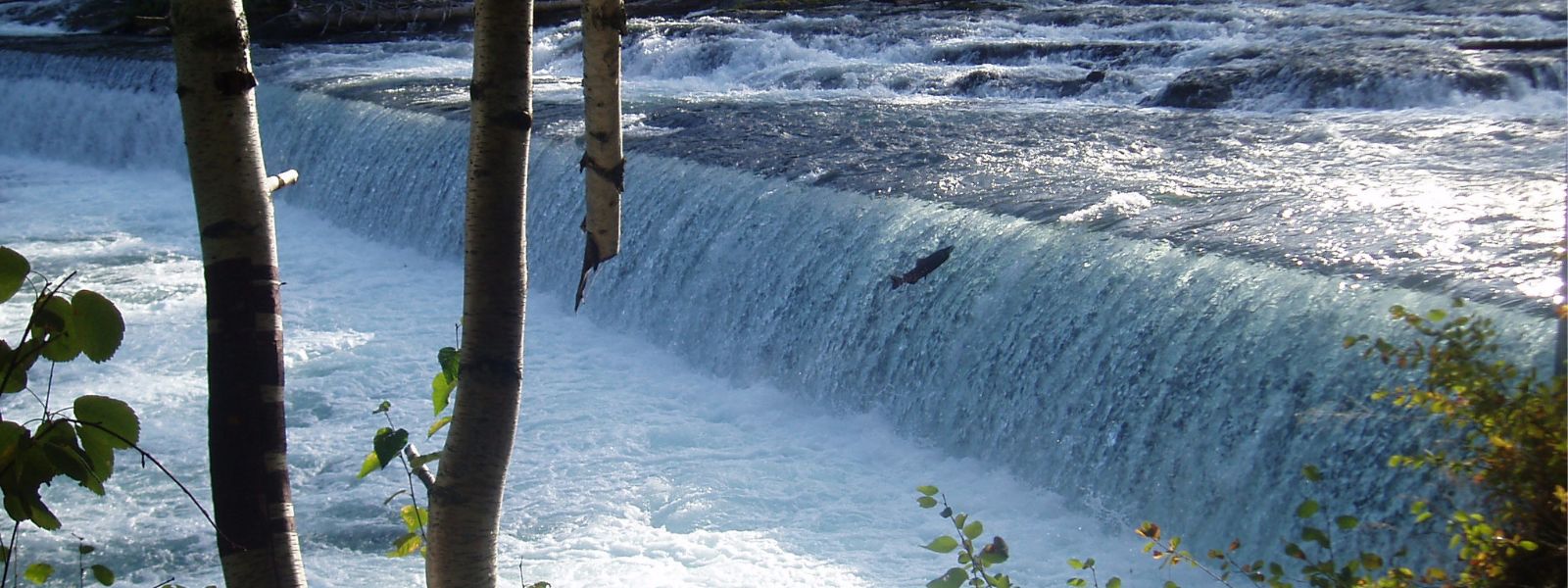
Climate change threatens the Gitanyow way of life, affecting water quantity and subsequently the cultural keystone of salmon fisheries. The Climate Test was a response to these pressures. Initially developed in its preliminary form in 2019 and under refinement since 2023, it uses a series of criteria and a scoring rubric to inform major project approval decision-making. It is but one of numerous attempts by Indigenous Peoples in Canada to exert sovereignty in a colonial legal landscape and in an economy that is grounded in natural resource extraction.
The Gitanyow are an Indigenous people, as referred to in the United Nations Declaration on the Rights of Indigenous Peoples (UNDRIP), and an Aboriginal people as defined in the Canadian constitution. The Gitanyow Huwilp (Nation) is a collective of eight Wilp (house groups) with 6,200 square kilometres of Lax’yip (territory) spanning swaths of both the Skeena and Nass river watersheds in the northwest of B.C. Gitanyow have stewarded this territory for millennia, and like many other First Nations in B.C., Gitanyow have never ceded, surrendered, or sold their territory.
Gitanyow experience with colonial Impact and Environmental Assessments
The Gitanyow Climate Test, and its overarching WSAP, was borne out of dissatisfaction with how major project Impact Assessment (IA) has dealt with Indigenous interests and climate.
Between roughly 2009 and 2018 Gitanyow had participated in several provincial environmental assessments and federal impact assessments prior to developing the WSAP, and found that the result was consistently similar—projects were approved regardless of the concerns raised by Indigenous Peoples and others.
During this period, Gitanyow, alongside many other First Nations in B.C., were calling for adoption and implementation of the UNDRIP and its specific articles related to free, prior and informed consent for industrial development on Indigenous lands, and associated rights of self-government and self-determination.
Indigenous influence on Impact Assessment and Indigenous-led Impact Assessment
The current legal landscape of Canadian impact assessment is rooted in centuries of European colonization and the institutionalization of extractive natural resource practices. In the 1970s, Indigenous interests were largely ignored. The landmark Berger Inquiry (1974-77) departed from this, providing space for more fulsome engagement of Indigenous people and elevating their rights and interests in Canadian natural resource decision-making1. While the Berger Inquiry remains a standout, ensuing Indigenous successes in the courtroom have incrementally strengthened the protection of Indigenous rights and interests in Canadian law. Most recently, there has been a broader movement towards reconciliation of past and ongoing colonial harms and a fairer and more just position for Indigenous Peoples.
Legally, this has been enshrined in provincial and federal impact and environmental assessment processes affecting Gitanyow. British Columbia’s Environmental Assessment Act (2018) and Canada’s Impact Assessment Act (2019) (IAA) both require consultation with affected Indigenous Peoples and the incorporation of Indigenous Knowledge into decision-making.
In parallel to this evolution in Canadian law2, Indigenous-led impact assessment (ILIA) has emerged as a means through which Indigenous nations are reaffirming their own values and procedures to make their own decisions on major project development and take back control over their territories3. From a legal standpoint, ILIA exemplifies a burgeoning legal pluralism, a trend which is a source of much disdain and opposition from certain segments of society4.
The British Columbia Law Institute defines legal pluralism as a description of the operation of two or more legal orders within the same geographical jurisdiction or social space5. Legal pluralism can be recognized and agreed upon formally, or can be asserted and recognized in a more contested and ad hoc manner, as is found in Canada.
Climate impact assessment in Canada and globally
The first consideration of climate change in Canadian federal IA appeared in 2003 policy guidance, a year after the Canadian ratification of the Kyoto Protocol and over a decade after global agreement on the United Nations Framework Convention on Climate Change6. In 2006, the tides turned: Canadians elected Stephen Harper’s government, which was intent on hydrocarbon development. Then, in 2011, Canada withdrew from Kyoto and a year later it had enacted the more hydrocarbon-friendly Canadian Environmental Assessment Act, 2012.
Against this backdrop, climate IA was weak at best7. A key fallacy in climate IA methods emerged at this time: what’s known as the scale trick. Essentially, it’s an approach that compares a project’s emissions to its host jurisdiction’s total emissions, inevitably resulting in a very small ratio and effectively diminishing any concerns. Climate policy gained new prominence with the adoption of the Paris Agreement in late 2015, and in the three following years the United States, United Kingdom, and the International Association for Impact Assessment released climate IA guidance8. Notably, British guidance did not use the scale trick argument, and instead suggested that all emissions be considered significant given the dangerously high concentration of greenhouse gases (GHGs) in the atmosphere9.
A change in government in Canada in 2015 led to a much more favourable political climate for Indigenous involvement in IA. Seeking to influence forthcoming policymaking, Doelle noted that inadequate major project decision-making can lead to climate impacts being locked in for long periods of time, stranded assets, or both10. Doelle (2018) and Gibson (2018) offered criteria to assess projects’ climate worthiness11.
Luke and Noble (2018) examined climate IA in B.C. liquefied natural gas (LNG) applications and found project splitting—where project components are assessed in isolation from one another—and insufficient linkage to climate policy, among other shortfalls12. B.C. introduced its landmark CleanBC climate policy in 201813, brought forth the Environmental Assessment Act in 2018, and revised the Climate Change Accountability Act (SBC 2007 c.42) in 2018 to include legal targets for emission reductions.
In 2019, the Canadian government enacted its current IAA, introducing an explicit climate test into Canadian federal IA legislation alongside other climate policy announcements14. Under sections 22 and 63 of the IAA, proponents must assess their project’s potential to “hinder or contribute to the Government of Canada’s ability to meet its environmental obligations and its commitments in respect of climate change”15.
In 2023 B.C. went on to further advance climate policy by introducing more stringent climate requirements16. These requirements included requiring all proposed LNG facilities to pass an emissions test with a credible net zero plan by 2030, and establishing a regulatory emissions cap for the oil and gas industry to ensure B.C. meets its 2030 emissions-reduction targets.
Nonetheless, Hetmanchuk’s 2020 review of climate IAs across Canada found only one that concluded that there would be significant climate effects, which she attributes to use of the scale trick17. Case study co-author Chris Joseph labelled the scale trick a “minimization argument” and noted that the global significance threshold of 350 parts per million carbon dioxide (the atmospheric levels considered safe by some climate scientists) had already been surpassed.
Joseph suggested that projects with climate impacts might still be justifiable based upon other benefits to society, and Doelle and Sinclair (2021) similarly proposed several criteria for when climate impacts could be considered justified18. Peloffy et al (2022) identified various loopholes and shortcomings in Canadian climate IA, proposing a test revolving around compatibility with decarbonization pathways and fair shares of the global carbon budget19.
This unreliable colonial government commitment to climate action adds to the general dissatisfaction with current IA processes and approaches and helps contextualise the emergence of the Gitanyow’s WSAP and climate test.
The Gitanyow People and assessment process
Gitanyow initiated the WSAP in 2019 after decades of experience participating in colonial impact assessments with minimal consideration of climate impacts. The WSAP is an example of not just ILIA but of the legal pluralism that exists in B.C. and Canada at the intersection of major project development, climate, and reconciliation.
Since contact with Europeans in the late 18th century, Gitanyow has defended the Lax’yip through direct and legal action, negotiation, and diplomacy. The effort to defend the Lax’yip has been and continues to be led by the Simgigyet’m Gitanyow (Hereditary Chiefs, or GHC) working on behalf of the Wilp20.
Major project development, ongoing human activity such as forestry, and global environmental change have all been transforming the Lax’yip. Climate change is a prime example of the latter, which in the Lax’yip manifests as glacial melting, increasingly severe wildfires, and ecosystemic change—all affecting Gitanyow culture, livelihood, and well-being.
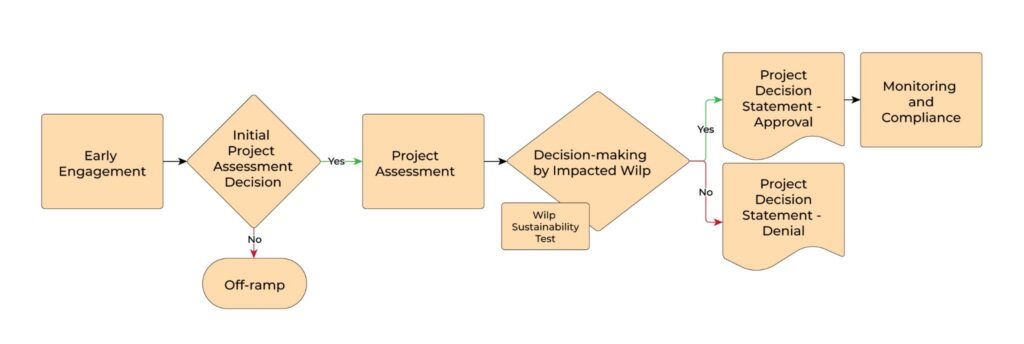
In response, Gitanyow have enacted several Ayookxw (laws) to shape development in or affecting the Lax’yip, including the WSAP21. The WSAP guides Gitanyow’s decisions with respect to major project development proposals, involving early engagement and project screening, detailed assessment, reporting, decision-making, and monitoring (Figure 1). Gitanyow undertakes the WSAP independent of the decisions of any neighbouring Indigenous nations, and to date three projects have been assessed through the process.
Figure 1. Gitanyow Wilp Sustainability Assessment Process
The initial WSAP was developed by Gitanyow Hereditary Chiefs and the first author of this case study, Tara Marsden/Naxginkw, in 2020 for the GHC with the support of West Coast Environmental Law. It included a preliminary climate test revolving around two criteria: whether a project’s design will minimize its carbon pollution and how a project might impact B.C. and Canada’s abilities to meet the Paris Agreement. The limited scope and vague articulation of these two criteria led the GHC in 2023 to initiate expansion and development of the climate test, which is when the second author, Chris Joseph, became involved.
Methods of development of the Gitanyow Climate Test
Starting in 2023, we reviewed and expanded the preliminary test through a five-step process. First, we re-examined the purpose for the test, clarified objectives for it, and explored gaps in the existing test and in colonial climate IA. We next reviewed relevant literature and engaged with several subject-matter experts (Robert Gibson, University of Waterloo; Graeme Reed, Assembly of First Nations; Thomas Green, David Suzuki Foundation) to identify opportunities. Third, we synthesized the research to use in drafting the new test and an accompanying evaluator’s guide. The fourth step was to engage with Gitanyow Chiefs and representatives for feedback. Finally, we applied the new test to two case study projects (Eskay Creek mine, and Ksi Lisims LNG project); the draft results were presented to Gitanyow Chiefs and representatives, then finalized.
New Gitanyow Climate Test
The new test is a response to a number of deficiencies in current B.C. and Canadian climate IA approaches. First, these governments have a poor track record with respect to emissions reduction. Both provincial and federal emissions trajectories are essentially unchanged since the mid-1990s, despite both orders of government introducing policy including legislated emission reduction requirements—a predictable outcome given repeated approval of fossil fuel projects22. More regression will not be surprising in the current political environment23. Second, Gitanyow recognize the disconnect between politically-negotiated targets and the Earth’s biophysical systems—politically-set targets are currently insufficient to keep the rising temperature down. Third, Gitanyow see little progress in the climate performance of approved projects, and a lack of material effect from IA overall. Fourth, Gitanyow observed inattention in B.C. and Canada’s limited climate tests to several dimensions of climate change24. As such, Gitanyow has sought to build upon its initial climate test to best inform its own decision-making, shape the trajectory of climate change and its effects on the Lax’yip as much as possible, and strengthen Gitanyow sovereignty25.
Consistent with the WSAP, as well as good practice in IA26, the new test was designed with several principles in mind:
- Rigour, transparency, and use of best available evidence;
- Simplicity and pragmatism to minimize burden on and maximize willingness in Gitanyow analysts and development project proponents;
- Applicability to all types of projects;
- Multi-dimensionality so as to best inform decision-making while at the same time minimizing overlap and duplication;
- Greater scrutiny for higher-risk projects27; and
- Putting the onus on proponents to demonstrate project benignity28.
The test is applied during the WSAP, which is triggered when a project that is in or that may affect Gitanyow Huwilp or Lax’yip triggers a review under B.C. or federal IA law. Once a proponent submits an Initial Description of Activities report to Gitanyow, the WSAP begins and the climate test is launched in parallel. The Impacted Wilp and Hereditary Chiefs may also trigger the WSAP for major projects that provincial and federal governments have not deemed reviewable under their respective legislation, which may now be occurring more as a result of fast-track legislation and exemptions of project review requirements.
The test involves three steps: (1) initial scrutiny of a proposed project, (2) criterion-by-criterion assessment including further information gathering, evaluation, and documentation of findings, and (3) summarizing findings of the evaluation as a whole in a climate impact report (Figure 2).
Figure 2. Three steps of the Gitanyow climate test

The first step of initial scrutiny is substantial in its breadth and depth, covering: the nature of the proposed project, quality of evidence, assumptions, uncertainties, and risks29, scope of assessment (e.g., whether there is any project splitting)30, mitigation plans, and relevant technical matters (e.g., use of appropriate GHG time horizons)31.
The second step examines the project on a criterion-by-criterion basis using a total of 13 criteria and sub-criteria (Table 1), along with a scoring rubric that defines good, fair, and poor scores for each. Detailed guidance is provided for each of the issues underlying each criterion and to help evaluators make their assessment. Evaluators applying the test can include independent technical experts and Gitanyow staff and leadership. The key questions listed in Table 1 seek to succinctly communicate the issues under examination for the evaluators and the reader of the test and test results.
Table 1. Criteria in the new Gitanyow climate test
| Number | Criterion | Sub-criterion | Key Question |
|---|---|---|---|
| 1 | Project Design and Mitigation | Ambitious Design32 | Does the design reflect ambition to address the climate crisis? |
| 2 | Adherence to Mitigation Hierarchy33 | Is prevention prioritized? | |
| 3 | Plan for Improvement34 | Is there a genuine and solid plan to improve the project’s climate performance over its lifespan? | |
| 4 | Implementation and Effectiveness Monitoring35 | Is there appropriate monitoring of, and response to, climate performance? | |
| 5 | Confidence in Explanation36 | Does the information provided give confidence in successful climate performance? | |
| 6 | Climate Lock-in37 | Is the project going to lock-in climate impacts for long periods of time? | |
| 7 | Climate Impacts | Comparison to Peers38 | How do the project’s GHG emissions compare to peers? |
| 8 | Scope 3 Performance39 | What is the extent of the project’s lifecycle GHG emissions? | |
| 9 | Climate Targets and Budgets40 | Does the project help or hinder its host jurisdiction’s climate objectives? | |
| 10 | Other Climate Effects41 | Are there any indirect or spillover effects of a climate nature? | |
| 11 | Distributional Inequities42 | Are there any groups that will be disproportionately affected by the project’s climate impacts? | |
| 12 | Economic Viability43 | Is the climate mitigation affordable to the proponent? | |
| 13 | Proponent Environment-Social-Governance (ESG) | Does the proponent’s corporate behaviour and history give confidence in climate performance? | |
The third step is the documentation of the results across criteria for inclusion in the broader WSAP. Draft results are shared with proponents and Gitanyow leadership, and then finalized based on any new information that comes to light. The final assessment report is then used by Gitanyow leadership to make what’s referred to as a “significance decision,” in other words a decision on the acceptability of a proposed project.
Case studies
The new climate test has now been applied by the authors to three projects: the brownfield Eskay Creek mine, the Ksi Lisims LNG project, and most recently a third project not profiled here. These are the first applications of any Gitanyow climate test, as the test in its initial form was never used to evaluate a project.
Eskay Creek
Skeena Resources recently sought the provincial government’s approval to reopen the currently-shuttered Eskay Creek gold and silver mine located northwest of Gitanyow territory. Its truck traffic would pass through Gitanyow territory, posing a number of risks to sensitive ecosystems and wildlife such as moose and grizzly bear.
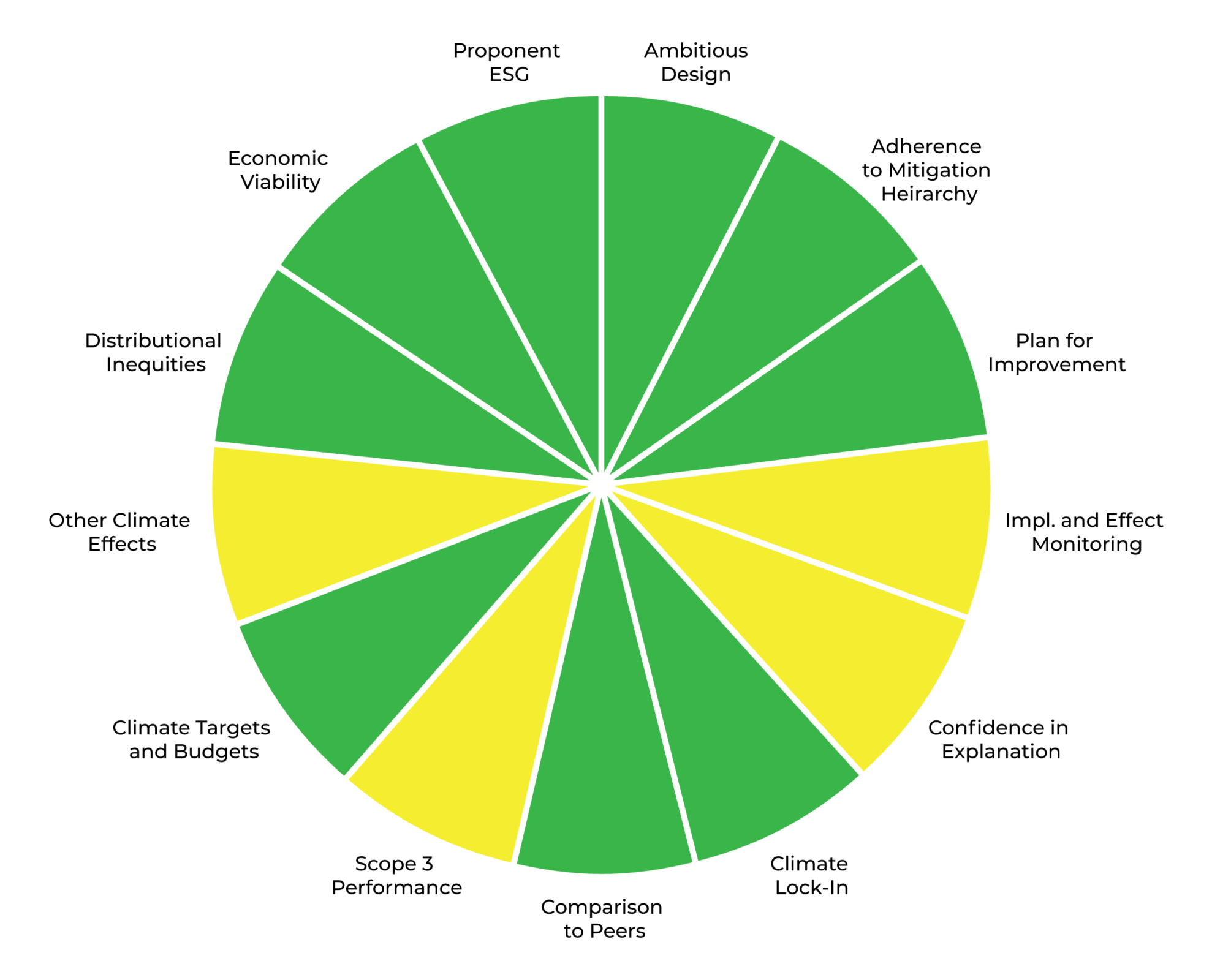
Skeena agreed in 2022 to participate in the Gitanyow WSAP and provided information for the evaluation, which was completed in 2024. While this project on its face does not pose many negative climate impacts, the climate test was applied as part of the broader WSAP evaluation. Overall, the project received nine “good” and four “fair” scores (Figure 3)44. To elaborate on two of these scores for the purposes of illustrating how the climate test works, the project received a “good” score for Comparison to Peers due to its low anticipated GHG intensity (due to high ore grade, availability of clean electricity, and it being located at the site of an old mine—also called a brownfield), whereas a “fair” score was given for its Scope 3 Performance due to Skeena’s unclear emissions estimate and limited interest in mitigation. Scope 3 Performance refers to emissions linked to a project either upstream in the supply chain or downstream from the use of the product.
Figure 3. Climate test results for Eskay Creek mine (“good” scores are green and yellow signifies “fair”)
Ksi Lisims LNG
The Ksi Lisims LNG project includes a proposed pipeline that would pass through Gitanyow territory, as well as a proposed export facility located northwest of it. Ksi Lisims LNG’s multiple proponents did not agree to participate in Gitanyow’s WSAP, but the project was evaluated nonetheless over 2024 and 2025 using publicly available information.
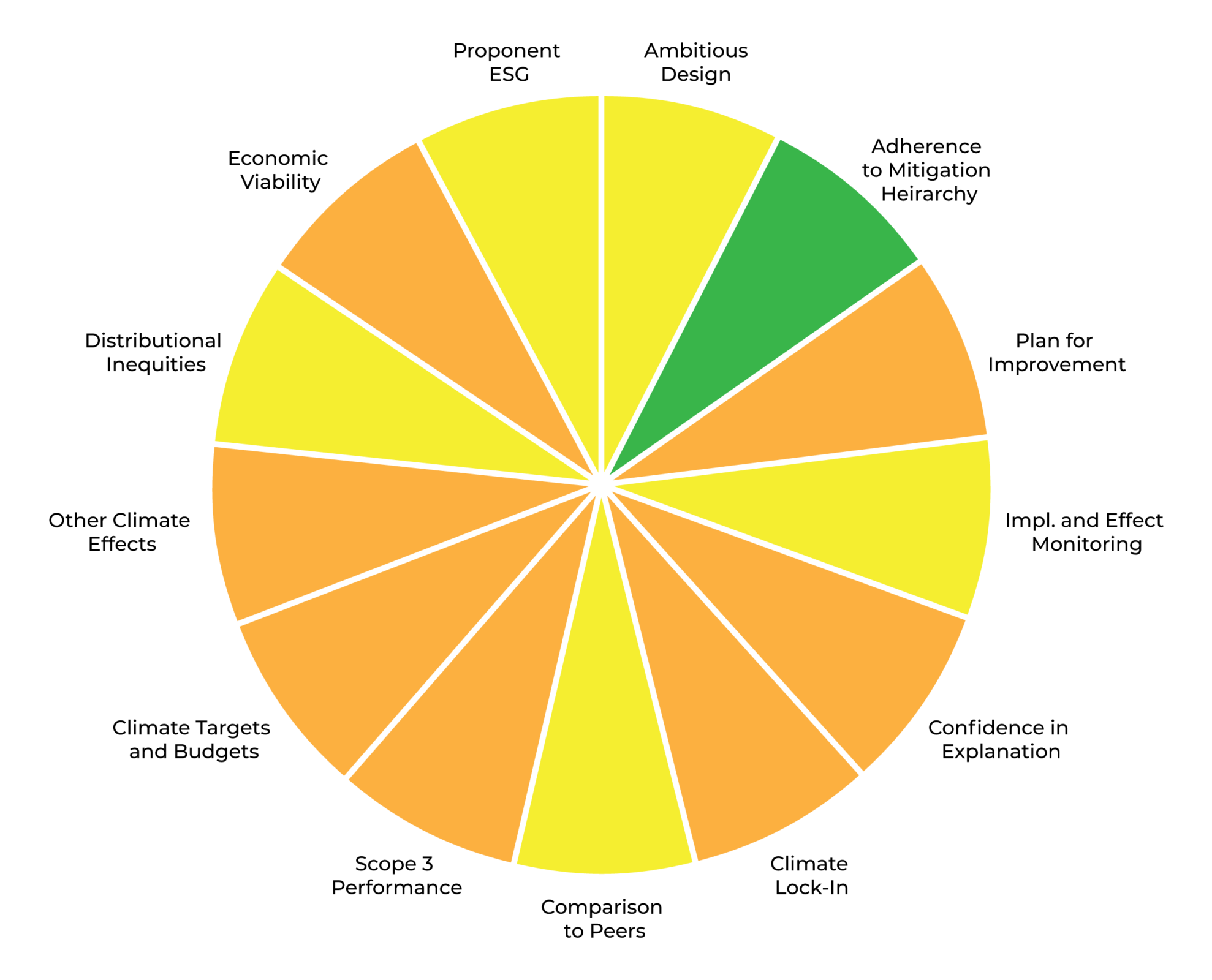
As a fossil fuel development, the project raised obvious climate impact issues and the climate test was an important part of Gitanyow’s evaluation. Overall, the project received one “good”, five “fair”, and seven “poor” scores (Figure 4). To elaborate, the project received a “fair” score with respect to Adherence to Mitigation Hierarchy because the electrification of the liquefaction process will avoid a substantial proportion of the project’s climate impacts, even though the proponent plans to rely on offsetting primarily until electrification is possible.
Figure 4. Climate test results for Ksi Lisims LNG (“good” scores are green, yellow are “fair”, and orange are “poor”)
Conclusion
Climate change is already profoundly impacting the Gitanyow territory and people, and consequently they have felt compelled to act. From Gitanyow’s perspective, the provincial and federal governments are failing to achieve climate progress. The climate test within the WSAP plays an important role in Gitanyow people being stewards of the territory for future generations, addressing the shortcomings of colonial impact assessment and climate action, providing transparency for major project impacts, and propelling change.
The advent and implementation of the Gitanyow climate test within the broader WSAP demonstrate the evolving legal landscape in Canadian IA and climate mitigation. In B.C. especially, legal pluralism has been evolving with the jurisdictional overlap of provincial and federal colonial law in addition to numerous independent and sovereign Indigenous nations.
Indigenous-led impact assessment is increasingly playing a role in how projects are assessed, whether they are approved, and in influencing the conditions for approval. Indigenous Peoples in particular—whose cultures, lifestyles, and economies revolve around the natural environment—are particularly engrossed in driving change in how proposed projects are assessed for their climate impacts.
IA, Indigenous reconciliation, and climate policy activism are intertwined and evolving, despite pushback against each by opposing interests.
Evaluation through the Gitanyow climate test has now been completed for three projects since its initial unveiling in 2020 and subsequent revision in 2023. Gitanyow remains open to further revision of the climate test based on new scientifically-proven methods and best available information.
While Gitanyow’s relationship to the land and stewardship of it is not new, the climate test and WSAP are recent expressions of Indigenous laws. Implementation of Indigenous laws in the face of colonial incursion is often hamstrung by the provincial and federal government’s denial of recognizing Gitanyow authority, but there is evidence nonetheless of the potential to nudge project climate performance, push colonial IA practice, and advance reconciliation.
Acknowledgements
The authors would like to thank the Gitanyow Hereditary Chiefs for supporting the development of the climate test and this article.