Shotguns and canoes
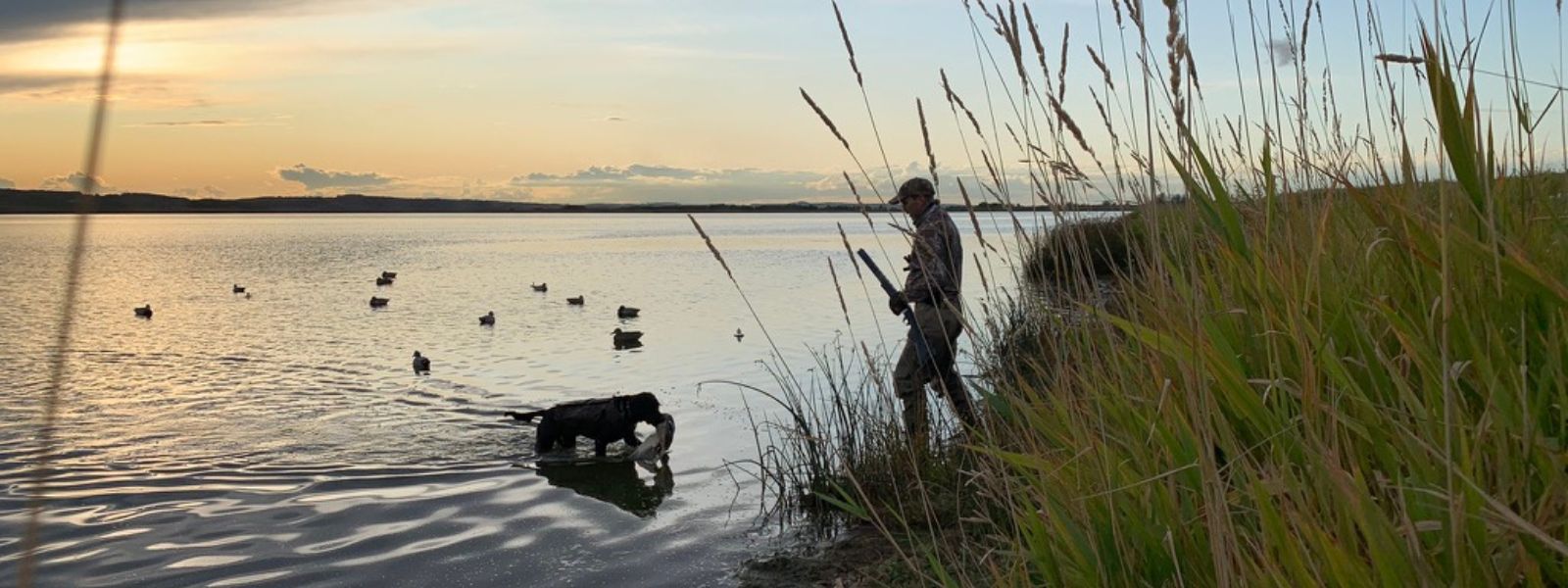
In 2012, I won a poetry award in my undergrad and used the $1,200 to buy a shotgun and a canoe. My professor told me that was a first. Most people used the cash to go on a trip to Europe. I’d be bringing my new shotgun and used aluminum canoe to Buffalo Pound Lake in the fall. The money from a new government job covered a 1998 blue Chevy Lumina. For the first time since I was a kid, I could actually get out on the land. Stock the freezer. Bring something home to my Grandparents and community. For years before that, I had been stranded in Edmonton with student debt, five bucks in a bank account, no vehicle, and the particular ache of knowing the land was out there and not being able to get to it.
That freezer, the one I finally got to fill again, is what this case study is about. Not literally, but the knowledge system it represented. The understanding, built across generations of Métis harvesting in the lands and waterways surrounding Edmonton, Alberta that the land is not a backdrop to human life, but a participant in it. That harvesting is not extraction but relationship. And the people who have maintained that relationship across decades of displacement, colonial legislation, industrial development, and the particular Canadian talent for pretending none of that happened—they are carrying some of the most detailed and longitudinal climate knowledge in this territory. It just does not come in a format that fits into a government report.
This case study argues that Métis harvesting narratives are not supplementary data. They are primary data that predate the colonial institutions’ reliance on scientific data. The dominant frameworks for understanding climate change and the impacts on the environment were built by the same colonial project that spent three centuries actively removing Métis people from the territories they understood best. That the resulting knowledge gap is now being addressed with consultation processes and Traditional Ecological Knowledge annexes is not quite enough. The stories are the data. The rest is catching up.
[Click to see in English] sîsîpak kâ-ayâcik ekota kâ-tipiskâk
omisi esi tânisi âpihtawikosisân kiskeyihtamowin ohci anima askiy esi âsônamihk. nimâmitoneyihcikanihk, nîsosâp kâwi nitahtopiponân, nimosôm ekwa niya e-samakîyâhk mâswâniskâhk ekota ihkatawâhk (e-pahkwâk ihkatawâw) ekota kâ-cîpâyikamik ispacinâsa sâwanohk moscâstani sîpiy. namôya nikihcinâhon tânisi anihi aspacinâsa esi wîyihkâteki eyiko wîhowin, ekosi anihi nimosôm kâ-esi wîhahk. namôya ceskwa oyasiwewin pâskisikewin wâsaskotawek. anima paskwâw pîsim kâ-pe-sâkewet mistahi tâpiskoc mihcet osâwi-mihkwâw, mihkwâw, ekwa nîpâmâyâtan, ekwa ekota kâ-tipiskâk nipihtawânânak sîsîp mîkwanak ispimihk ekota kâ-nîpawiyâhk. nikwecimâw tânihki tepiyâhk kâ-pâskiswâyâhkik nâpew sîsîpak. niwihtamâk ekwa moy e-kinwâpamit. kinitaweyimânawak iskwew sîsîpak sâwanohk kâhesiyâcik, itwew. ka-wîyinocik. kâwi ka-pe-kîwîyâcik ka-owâwicik. miyo kîsikâw ohci aniki sîsîpak.
namôya awiyak miyikiw masinahikan. namôya awiyak nimiyik nîsta kîkway. kiskinwahamâson ekota ka-ayâyan. kikiskinwahamâson tânisi sakâw esinâkwahk kâ-miywâyâk pihci kîkway moy kwayask. kikiskinwahamâson, eta namôya kîkway awiyak e-itwet, kiya poko ka-wihtaman kîkway kâ-kîwihtâyan pihtaw kiwahkômâkanak e-wî-mîcitik.
anima Manitoba Metis Federation wiyasiwewin ohci mâcewin wihcikâtew kîkway mâcewak âsay itôtahkik: eyikoni âpihtawikosisânak mâcewin okimâwewin e-osihtâhk ekota tâpowakeyihtamowin ana omâcew ekota askîhk ohci, moy kinwâpahtahk ohci wayawetimihk. anima kiskeyihtowin moy ohpime ihtakon ohci anima kâ-esi wahkohtômakahk eta kâ-osihcikâtek eyikwânima, eyikwânima ohci tânihk moy kâ-pimâtahk kâ-otinikâtek ekwa nâstâhk.
Ducks in the darkness
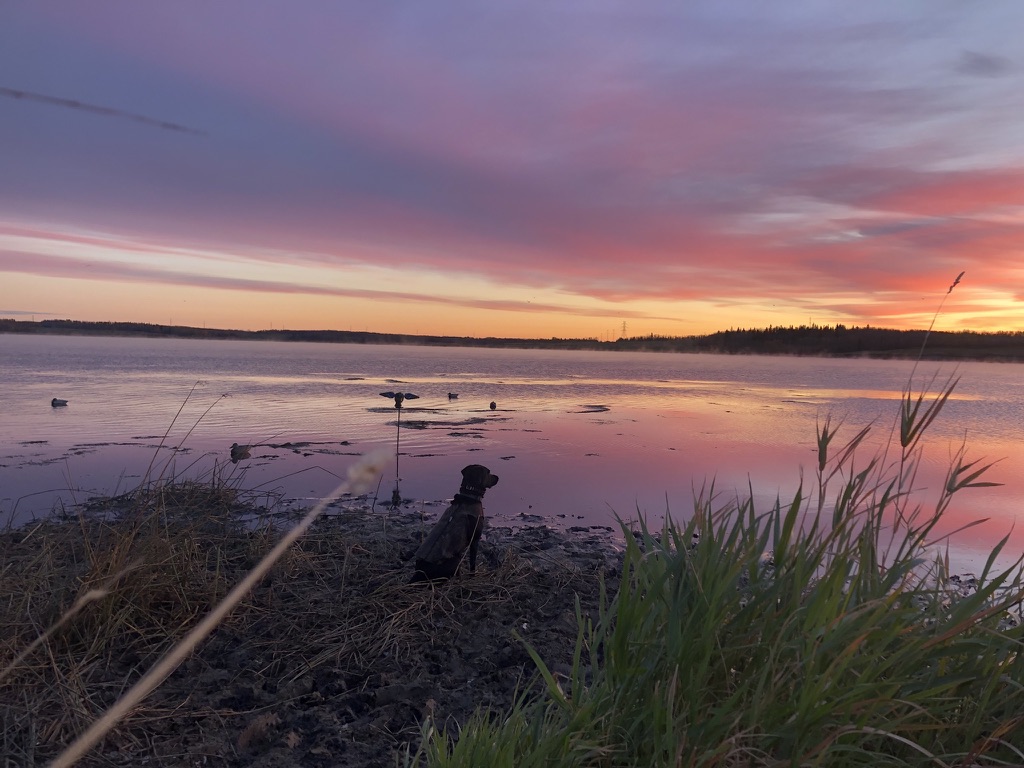
Here is how Métis knowledge about land actually gets transmitted. In my mind, I’m 12 years old again, my Grandfather and I are crouched down in the reeds off a tiny pothole slough (a shallow marshland) in the Haunted Hills south of Moose Jaw. I’m not sure where the hills got that name, it was just how my Grandfather referred to them. It is not legal shooting light yet. The prairie sunrise is creeping out in a thousand shades of orange, red, and purple, and in the darkness we can hear the swoosh of duck wings passing over us. I ask him why we only shoot the drakes. He answers without looking at me. We need the hens to go down south, he says. Get fat. Come back and lay eggs. It is a good day for the ducks.
Nobody handed him a manual. Nobody handed me one either. You learn by being there. You learn what the bush looks like when it is healthy versus when something is off. You learn, without anyone saying it directly, that you are accountable for what you take home because your family is going to eat it.
The Manitoba Métis Federation’s Laws of the Harvest codifies what harvesters already practice: that Métis harvesting governance is built on the principle that the harvester is embedded in the ecosystem, not surveying it from the outside. The knowledge does not exist separately from the relationship to place that produced it, which is why it does not survive being extracted and filed.
My experience as a Métis harvester in Treaty 6 territory is treated throughout this paper as evidence, not as illustration and not as colour, but as data. University of Michigan Professor Kyle Whyte’s 2017 foundational work on Indigenous climate change studies makes the theoretical case for this: dismissing lived experience as subjective while treating remote sensing as objective is a political choice dressed up as methodology. The harvesting knowledge that comes from four generations of being in relationship with a specific piece of land is more granular, more longitudinal, and more place-specific than almost any formal monitoring system currently operating in these territories.
Sharp-tail grouse dancing on a lek
My Uncle, Father, and good family friend and I scattered my Grandfather’s ashes in an abandoned pioneer graveyard in the Haunted Hills. The four of us walked across a washed-out clay road in rubber boots, my father and I carrying our Italian-made Benelli shotguns, my uncle carrying a green shoebox with my Grandfather’s ashes in a plastic bag. No speeches. No ceremony beyond a mickey of Canadian Club passed around and some poured out on the ground. Then my uncle opened the ashes and they dropped into the prairie soil on the wind, and we stood there thinking about the man who had brought us all into this world and into this particular piece of country and instilled an intimate knowledge of the landscapes around us.
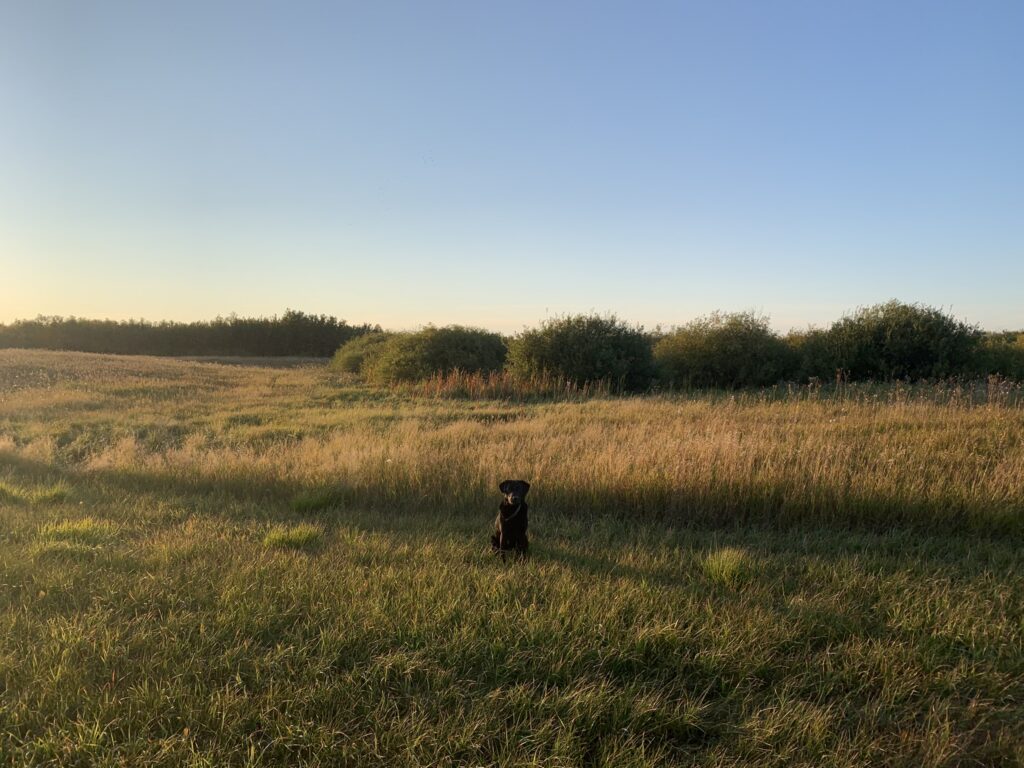
Then, forty sharptail grouse came out of nowhere and buzzed us. Close enough to hear the wind off their wings. The family friend, waiting back at the trucks, dropped two. His black lab went to retrieve them before the dust from the ashes had settled. My father said the grouse gave Grandpa a forty-wing salute and only thirty-eight flew away. That is a precise observation. It is also a data point. Forty sharptail grouse in a covey, in country where my dad said he had not seen a flock that size since Grandpa’s younger days. Not a climate model. A specific observation in a specific place by people who had been watching that country for decades. That is what this kind of knowledge looks like, and that is what gets lost when the people who hold it are no longer on the land.
The Otipemisiwak Métis Government’s Mámawi Nistam report documents exactly this pattern: community members flagging changes in species populations, berry yields, and freeze-thaw cycles well before those changes showed up in official monitoring systems. The harvesters were not wrong. There is no more rigorous accountability structure than a family that eats what it brings home. If you stake your winter food supply—the full freezer—on a flawed observation, it can’t be solved in peer review.
Old gravel roads
My Grandmother never stopped harvesting from inside the city. On her daily walks around Beaumaris Lake—an urban man-made lake in Edmonton’s northside—she would cut into the yards backing onto the path and take produce from people’s gardens. When the saskatoon berries came in, she would take the bus down to the river valley and walk the trails filling four-litre ice cream pails, on the same paths her Granny had walked coming out of the Papaschase community. She did not think of this as remarkable, it was just what you did. The city was terrain, same as any other, and she read it the same way.
That is how harvesting knowledge works. It is not stored in a curriculum. It is carried in the body, accumulated across seasons, transmitted through doing. My Grandfather did not use a rangefinder or a mapping app. He had a .22 with a bent barrel and a Coleman propane stove on the tailgate and he would know which caragana rows held coveys of partridge and grouse. When he checked a grouse’s crop to see what the bird had been eating, while frying up its breast and heart, he was practicing field ecology. He just called it lunch.
The same report discusses Métis harvesters adjusting routes, timing, and methods in response to changing conditions—not as crisis management, but as ordinary practice. The adaptability is not new. The Métis were and are always moving, always reading, always adjusting. What is new is the rate at which conditions are changing, and the degree to which the systems harvesters relied on to orient themselves are coming unmoored from the patterns that made them legible.
The old gravel road we drove to get to the gravesite had not seen a grader in a few summers. My Grandfather used to cruise it in an old station wagon with no winter tires, back before that was even a thing people thought about. He got stuck constantly and a lot of walking to random farms to borrow a phone or a tractor. That was a different relationship to uncertainty. You expected the road to be bad and you managed it. What is harder to manage is when you expect the road to be fine and then it is not, and you cannot tell whether this year is an anomaly or a new pattern.
Saskatoon berries
Nobody who has been harvesting in this territory for more than a decade needed to be told the climate was changing. They had been watching it change. The question most of the harvesters had was why it took everyone else so long to notice. Why had policymakers not reacted as familiar rhythms were increasingly interrupted by unpredictable swings?
The saskatoon berries are the thing that comes up most when I think about what has shifted in my own lifetime. My Grandmother knew every slope along the river valley where the berries came in earliest. She knew which bushes to check first by reading the angle of the hillside and the direction it faced, knowledge that had been tested across so many seasons it had become instinct. She filled those four-litre pails reliably. When I returned to the same spots after years away, the timing was off. Some years, the berries came in a full two weeks earlier than they should have. Other years, they got hit with a late frost right at the peak and there was almost nothing. The pattern that her knowledge was built on, the pattern that told you when to get on the bus and where to walk and which bushes to start with; that pattern has become unreliable in a way it was not for her generation. The knowledge still exists. The conditions it was built on are shifting underneath it.
That first fall back on the land, after the shotgun and the Lumina, the country felt different from how I remembered it as a kid. Not dramatically different. Just off, the way a familiar voice sounds wrong on a bad phone connection. The Métis National Council’s 2025 Climate Change Strategy documents this cascading effect in detail: altered freeze-thaw patterns disrupting fishing access, early snowmelt collapsing trapping seasons, berry ripening going sideways in ways that cannot be planned around.
When the patterns your Grandparents knew stop being reliable, you lose not just the information, but also the framework that made the information meaningful.
Spring is the most destabilized season now. It arrives earlier but not consistently earlier. It lurches forward and falls back in ways that confuse both the animals and the harvesters. Moose are showing up in places where they were not expected and are absent from places where they have always been.
Empty freezers
Jacob Sansom had just been laid off when he and his uncle Maurice Cardinal drove north to hunt Crown land near Seibert Lake, Alberta. That is what you do when the work dries up and the freezer is getting low. That is what Métis people have done for generations. You go to the land. It is not a romantic impulse. It is a practical one, the same practicality that had my Grandmother on the bus to the river valley with an ice cream pail, the same practicality that had me spending a poetry award on a shotgun instead of a trip to Europe.
They were shot and killed. The RCMP called it an isolated incident with no evidence of racial motivation. I have spent enough time in rural Alberta to know what that message gets across. I have stood in fields talking to settler hunters who told me I was lucky to be out there, implicitly challenging my right to be there at all, and I have nodded and laughed and ended those conversations as fast and safely as I could, because in rural Alberta a lot of people carry weapons in their vehicles and some of them are not afraid to use them.
The fear is not irrational. The Métis Nation-Saskatchewan Climate Change Strategy situates harvesting rights within food sovereignty explicitly: the right of peoples to define their own food systems, to maintain their own relationships to land and food sources, and to make decisions about harvesting according to their own knowledge and governance. When the atmosphere of threat makes harvesters afraid to leave the city, that right becomes theoretical.
The Métis Nation of Alberta’s community monitoring work tracks how environmental disruption compounds this: declining access to traditional food sources, driven by both ecological change and the social conditions that make harvesting dangerous or inaccessible, is pushing communities toward increased dependence on store-bought food. When you cannot harvest, you cannot teach harvesting. That is the long game of both environmental disruption and colonial violence. It’s not just about the food, it’s about the knowledge that sustains it.
Can’t eat oil
There is country west of Edmonton that does not look like itself anymore. Pipelines and oilfield access roads cut through habitat that used to be continuous. To access this country you used to need to know the land to navigate it. Now anyone with a half-ton truck can get in, which means everyone does, so the animals that relied on that difficulty of access for cover have redistributed or thinned out or stopped coming entirely. The physical structure of the harvesting territory has changed. Not metaphorically. Actually. The bush is different now.
The Haunted Hills country south of Moose Jaw is different too, though in different ways. The graveyard where we scattered my Grandfather’s ashes had been reclaimed by overgrown prairie grass and sage and caraganas. The tombstones that had not crumbled away were weathered smooth. A few of the gravesites were covered in the bones of sharp-tail grouse and rabbits, leavings from the big snow-white owls that ran the nights. There was something in that. The way the land had moved back in over the human marks, the way the owls were eating well in a place that had been abandoned. Abandonment and reclamation are not always the same thing. Sometimes the land knows what to do when people leave.
The problem is when people are pushed out of a landscape they were in relationship with, and the landscape changes without them, the knowledge of what it used to hold starts to go.
Bell and Paterson’s 2019 work on Métis harvesting rights in Canadian law traces how consistently those rights have been treated as subordinate to resource extraction. The practical effect is Métis harvesters across the Prairies are watching their territories degrade within a single generation, fast enough that you can name the specific year things started going wrong. I can. That specificity matters. It means the knowledge of what was lost is still alive in the people who watched it go, which means it is not too late to treat that knowledge as the primary evidence it is.
Contamination sits underneath a lot of harvesting decisions now, not loudly but constantly. You do not eat the fish from that drainage anymore. You are not sure if it is actually contaminated or just looks wrong, but you are not going to stake your family’s winter on finding out. The For Our Future: Indigenous Resilience Report documents this widespread and rational caution across multiple territories—communities pulling back from areas they have worked for generations because the industrial footprint has made certainty impossible. The precaution is sensible. It is also a form of dispossession that does not show up in any formal assessment of resource project impacts.
Reading a pothole slough
The climate change conversation in Canada takes place mostly in institutions that were not built for us and were not, for a long time, built with us in mind at all. That is not a hot take. It is a structural description.
The agencies and universities and policy bodies that produce climate knowledge were designed by the same project that spent generations excluding Métis people from decisions about their own lands. Adding a consultation process at the end of a study does not change the design. It adds a room to a building that was already finished.
My Grandfather was functionally illiterate. He enjoyed the pictures in Field & Stream and Outdoor Canada. I used to run across to Tim Hortons to get him a real coffee and come back with those magazines when he was in the hospital and we both knew he was not getting out to fish again. What he could do was read a pothole slough in the dark by sound, read a prairie horizon for weather coming in three days out, read a grouse crop to know what the bird had been eating and what the land was producing. That knowledge is not in any database. It accumulated across a lifetime of being in a specific relationship with a specific piece of land and being accountable to what you found there.
Whyte’s framework for Indigenous climate change studies argues that for Indigenous peoples, many of the conditions that climate discourse treats as future risks are already present. They are not warnings. They are histories. The harvesters in this case study are not being asked to imagine a warming scenario. They are describing what has already happened, in specific places, over specific decades, to specific populations of fish and grouse and berries and ice. That description is primary evidence. The Métis National Council’s Climate Change and Health Vulnerability Report makes this argument in policy terms: effective climate response requires treating Indigenous knowledge as primary, not supplementary, data. Natural Resources Canada’s Indigenous Resilience Report gestures toward this. Gesturing and restructuring are different things. One is a chapter. The other is a different way of doing the work.
Voices on the wind
What comes out of decades of watching specific territories change—specific sloughs, specific traplines, specific berry patches, specific coveys in specific country—is not a theory. The people who hold that body of knowledge have been watching the changes now showing up in formal datasets for twenty or thirty years.
If the goal is early detection and early response, the methodology of early detection should include the people who have been watching longest.
This is not a gesture toward inclusion. It is a methodological argument. Government climate monitoring systems need to be structurally redesigned to incorporate Métis observational knowledge as primary data, not as supplementary commentary appended after the analysis is already done. That means co-developing monitoring frameworks with Métis communities from the design stage, not the consultation stage. It means building data collection systems that are accountable to Métis experience and values, not just legible to existing institutional formats.
Food sovereignty and climate resilience are not separate issues that happen to overlap. They are the same issue approached from different directions. The erosion of harvesting access—through contamination, habitat loss, regulatory barriers, social threat, and the displacement that comes when the animals are no longer where they used to be—is simultaneously a climate impact, a food security crisis, and a cultural rights violation. The architecture of siloed policy built to keep these issues apart cannot adequately address what communities experience as one holistic system. Métis harvesters are not going to the land because they are performing culture. They are going because their families need to eat. That is what Maurice Cardinal and Jacob Sansom were doing. That is what my Grandmother was doing on the bus with her ice cream pail. It is the same thing.
Several policy directions follow from this. Métis governments need to update harvesting policy to reduce the administrative barriers that make access and licensing prohibitively difficult for their own citizens. Federal funding streams designated for Métis community harvesting and food sovereignty projects are needed, not as one-time grants folded into broader Indigenous programming, but as sustained, dedicated investment. Those projects must be designed to support intergenerational knowledge transmission. Anti-racism education and training within the institutions that govern land, wildlife, and public space is a precondition for any of this to work in practice.
The harassment that Métis harvesters face, the challenges to rights, the assumptions about legitimacy, the social conditions that make going out alone feel like a risk you cannot take, do not resolve themselves through policy language. It requires an active, sustained effort to build recognition of Métis rights and culture into the institutions whose agents are, in practice, the people harvesters encounter on the land.
The transmission of harvesting knowledge is itself a climate adaptation strategy, and it is being disrupted at exactly the moment it is most needed. Macdougall and McCallum’s 2018, work on how Métis knowledge travels through family and community shows what that transmission requires: time, proximity, access to the land itself, and enough seasons of doing things together that the knowledge moves from one generation’s body to another’s without having to be explained. When harvesting territories are degraded or inaccessible, when seasons are unpredictable, when the social conditions make going out alone feel like a risk you cannot take, the transmission breaks down. And once it breaks down, you do not automatically get it back when conditions improve. You have to rebuild it deliberately, which is slower and harder and less complete than keeping it going in the first place.
Funding, policy, and governance structures that treat this transmission as a climate adaptation priority—not a cultural heritage footnote—are overdue across every order of government that claims to be serious about resilience in these territories.
Filling the freezer
The first time I filled my freezer up again, after the poetry award and the shotgun and the blue Lumina, I drove the meat back to my Grandparents’ place and we filled their fridge freezer right up. Moose, duck, goose, wrapped in butcher paper with the date on it in black marker. My Grandmother did not make a speech about it. She just made room for it, same as she always had. That was the whole point. The freezer was evidence that the relationship with the land was still intact, that the knowledge of how to engage it had moved from one generation to the next, that the continuity had held despite everything that had tried to break it.
I said that this case study is about a freezer but that is a simplification. It is about the knowledge system that allows us to fill it through relationship with the land. The decades of observation about which areas hold moose and when, which hillsides the saskatoons ripen on first, which gravel roads flood out in a wet spring, and which ones hold. The understanding that the land is a participant, not a backdrop, and that the people who have been in relationship with it longest are carrying the most precise and longitudinal record of what it is doing and what is changing.
My Grandmother took the bus to the river valley and filled her ice cream pails on the same trails her Granny walked out of the Papaschase community. My Grandfather knew intimately the different bucks and does of the deer herds in the Haunted Hills. That knowledge is still here. Still accumulating.
Works cited
Gaudry, Adam. “Métis in Canada: History, Identity, Law & Politics, edited by Christopher Adams, Gregg Dahl, and Ian Peach.” Aboriginal Policy Studies, vol. 3, no. 1–2, 30 Mar. 2014, https://doi.org/10.5663/aps.v3i1-2.21709.
Gaudry, Adam, and Darryl Leroux. “White Settler Revisionism and Making Métis Everywhere: The Evocation of Métissage in Quebec and Nova Scotia.” Critical Ethnic Studies, vol. 3, no. 1, 2017, pp. 116–42. JSTOR, https://doi.org/10.5749/jcritethnstud.3.1.0116. Accessed 14 Apr. 2026.
Manitoba Métis Federation. Environment and Climate Change. Manitoba Métis Federation, n.d.,www.mmf.mb.ca/environment-climate-change.
Manitoba Métis Federation. Métis Harvesting. Manitoba Métis Federation, n.d.,www.mmf.mb.ca/harvesters.
Manitoba Métis Federation. Métis Laws of the Harvest: Guide to Métis Hunting, Fishing, Trapping and Gathering. Rev. 3rd ed., Manitoba Métis Federation, n.d., https://www.mmf.mb.ca/wcm-docs/docs/departments-citizenship/metis-laws-of-the-harvest_final.pdf.
Métis Nation–Saskatchewan. Climate Change Strategy Report. Métis Nation–Saskatchewan, n.d., https://mns.ca/uploads/public/img/Offices%20&%20Ministries/Lands%20&%20Environment/Environment%20Climate%20Change%20Strat%20Report%20_DIGITAL.pdf
Métis National Council. The Métis Nation Climate Change Strategy: Weaving Resilience and Building Métis Climate Leadership. Métis National Council, 2024, www.metisnation.ca/wp-content/uploads/2025/09/MNC-Metis-Nation-Climate-Change-Strategy-FNL-PDF.pdf.
Métis National Council. Métis Nation Climate Change and Health Vulnerability Assessment. Métis National Council, 2025, www.metisnation.ca/wp-content/uploads/2025/06/MNCHVA-FINAL-Report.pdf.
MNC Response to Environment and Climate Change Canada’s Draft Implementation Framework for the Right to a Healthy Environment, www.metisnation.ca/wp-content/uploads/2025/06/MNC-Response-ECCC-Framework-Report-1.pdf.
Otipemisiwak Métis Government of the Métis Nation within Alberta, and The Resilience Institute. Mâmawi Nistam Ahkamîmowin Iyakohci Siwîpana / Together First: Resilience Through Seasons—Climate Risk and Vulnerability Summary Report for Policy Makers. Nov. 2025, https://albertametis.com/app/uploads/2025/11/Mamawi-Nistam-Climate-Risk-Summary-FINAL_Nov_2025.pdf
Reed, Graeme, et al. For Our Future: Indigenous Resilience Report. Natural Resources Canada, 2024, https://changingclimate.ca/site/assets/uploads/sites/7/2024/03/Indigenous-Resilience-Report_Final_EN.pdf
Whyte, Kyle. “Indigenous Climate Change Studies: Indigenizing Futures, Decolonizing the Anthropocene.” English Language Notes, vol. 55, no. 1, 2017, pp. 153–62. Project MUSE, https://muse.jhu.edu/article/711473.