When we talk about doubling Canada’s electricity production by 2050 and electrifying the economy, we might not immediately think about the task at the scale of a single plug.
Governments across Canada are understandably focussed on prioritizing ambitious plans to enhance their electricity systems at major scale, from the recently announced expansion of Churchill Falls to interprovincial grid interties to gigawatt-scale offshore wind. Many of these projects have been referred to the federal government’s new Major Projects Office, signalling their role as critical infrastructure in the national interest. Blockbuster deals like these represent some of the most important steps Canada must take to meet its goal.
But alongside these big steps, many smaller steps can bring the benefits of electrification to Canadians where they live and work. Our recent report Leading the Charge found that the electrification of passenger vehicles across the country will require millions of these small steps—the 19 million charging ports that must be built by 2040 to ensure smooth travel for the roughly 21 million electric vehicles (EVs) that are expected to be on Canadian roads by then. That’s up from about one million today.
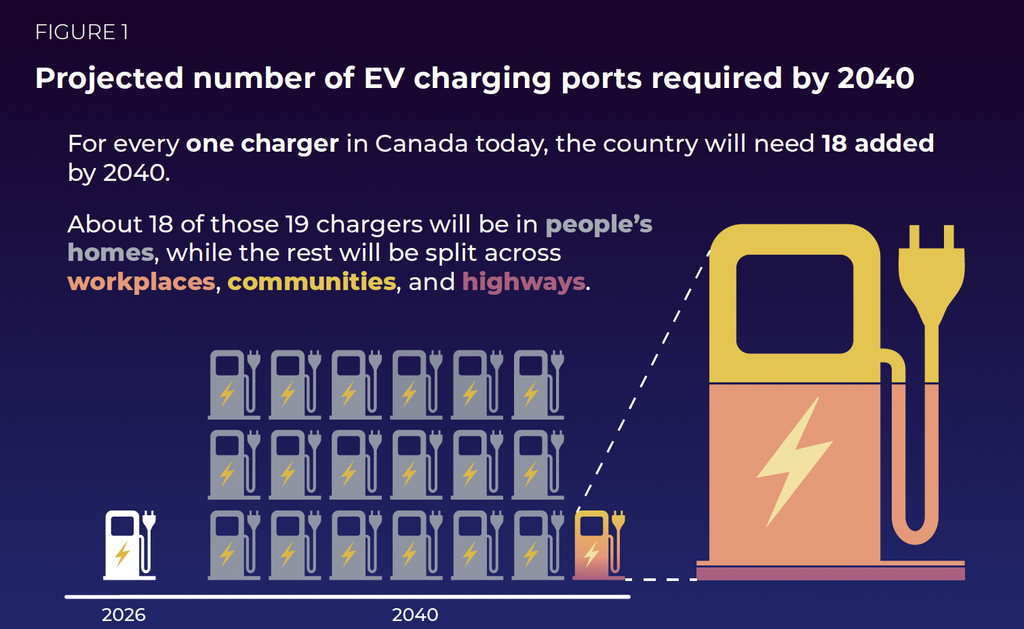
Net zero requires massive expansion of Canada’s charging network—with households adding the majority of new chargers
Transitioning from a nation run on internal combustion engines to one that operates mainly using electric motors is an essential element of Canada’s path to net zero. And EVs can do more than just slash transportation-sector emissions. There is enormous public benefit to easing the way for EVs: all those electric motors promise better air quality, improved health outcomes, lower costs for drivers, and improved grid flexibility and stability.
Increasing the total number of EV chargers across Canada by a factor of nearly twenty is a significant project, to say the least. But the vast majority of those future installations are expected to be in people’s homes, and most new chargers will likely be easily and cheaply installed when households purchase an EV.
This is a good news story for Canada’s energy transition, because it means governments won’t have to plan and build the bulk of the necessary infrastructure. The overall goal is ambitious, but most of the steps are as readily achievable as installing a new washer and dryer.
Targeted government interventions can help overcome major barriers to the charger buildout
This doesn’t mean government intervention is not needed. Government action is vital, and our findings can help focus the scope of that action in the upcoming federal charging infrastructure strategy. Our analysis identified four main barriers with the potential to block buildout and slow the transition to EVs, all of which require policy interventions to fully overcome:
- EVs and public charging infrastructure risk getting stuck in a chicken-and-egg dynamic—building more chargers depends on having more EVs on the road, while having more EVs on the road depends on having more chargers.
- In remote and rural areas, low utilization could remain a barrier to the private sector providing public charging for the foreseeable future.
- Residents of multi-unit residential buildings risk getting left behind due to split incentives, as well as the higher costs and complexities of installing EV chargers.
- EV charging could be an asset for the grid, if it’s built to enable flexible electricity demand—but in most places, it isn’t yet.
Addressing these barriers will be crucial for the success of Canada’s pursuit of net zero and for enabling Canadians to gain easier access to a healthier, more affordable technology. Actions taken to overcome these specific obstacles can also help to provide policy certainty on the overall path the country is taking on EVs and their charging infrastructure. This encourages markets and households to move in the same direction, accelerating and reducing the cost of the electrification of transport. Governments can then provide targeted funding for sectors the market can’t adequately address.
Governments can fill the gaps in Canada’s EV charging network with targeted action
We recommend an approach that tackles both the supply and demand sides of the chicken-and-egg problem. This approach combines broad, economy-wide regulatory approaches, specific changes to regulated electricity markets, and targeted funding support. There are critical roles in this for both the federal and provincial and territorial governments.
Automakers, charging providers, and Canadian EV owners alike need policy certainty to proceed with confidence in making their own investment and purchase decisions, to know that the infrastructure will be ready when they need it and customers will be there to use it. Yesterday, the federal government announced that the tailpipe emissions standards will remain at 2026 levels until 2030, which compromises this certainty in the near term.
Getting Canada back on track to reach its goal of 75 per cent EV sales by 2035 and 90 per cent by 2040 will require future tailpipe emission standards to ramp up quickly after 2030 in order to hit those targets.
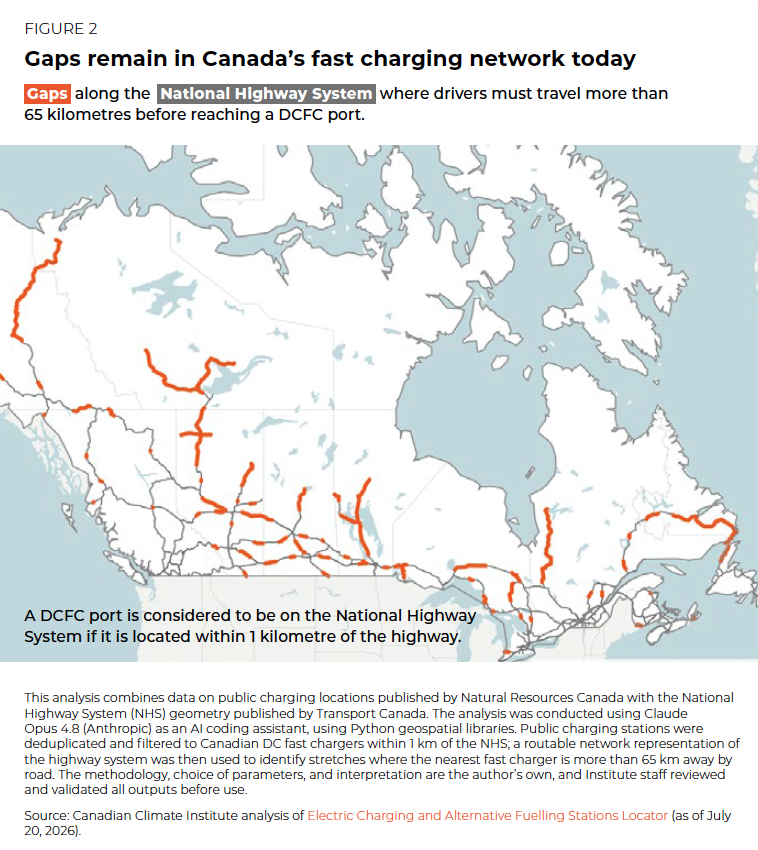
The federal government should also provide direct support for the buildout of charging infrastructure in rural and remote communities, to make the transition to EVs accessible to more Canadians. Currently, there are substantial gaps in Canada’s fast charging network across the national highway system that should be a focus of attention for policymakers.
The federal government should do the same for people living in multi-unit residential buildings, as can provincial and territorial governments, which have much more direct control over building codes and electricity grids. The latter should follow the lead of Quebec (and many municipalities across the country) and update building codes to regulate that all new MURBs are EV-ready. Provincial governments should also guide grid regulators to enable rate design that makes demand charges economically viable at all stages of the transition, and maximize managed charging for Level 2 chargers.
Canada’s vehicle emissions standards have been delayed but are still in the works, along with the federal charging strategy. These would be welcome developments, indicating that the government knows the right route the country needs to take to get to net zero. For many more Canadians in the years to come, that path will be travelled in an EV. The best way to ensure a smooth ride for all is to get moving now on building the charging infrastructure that will require. There are 18 million little steps from here to a fully electrified future for passenger transport.