This article was previously published in La Presse.
“We see the world with the same eyes.”
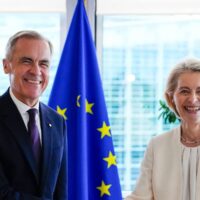
This is how European Commission President Ursula von der Leyen described the relationship between Europe and Canada in her recent State of the Union address, as she laid out the myriad opportunities opening up as the two trading partners signal their intention for closer co-operation.
High on the president’s list was climate action, a point her colleagues expanded upon in a recent draft memo prepared for the EU-Canada summit taking place in Montreal this week. The memo noted the importance of low-carbon energy, clean tech, critical minerals, carbon pricing, and industrial decarbonization—a set of priorities that could serve as a dynamic foundation for a partnership that is squarely focused on the future, not the past.
But if Canada and the EU see the rest of the world with the same eyes, it might be more accurate to say they can also see the missing pieces of their own picture when they look at each other through a climate lens. This is the truly transformative opportunity in closer ties—that Europe, for example, can acquire from Canada the scarce supplies it needs to complete its accelerating transition to net zero, while Canada can draw policy lessons and renewed motivation for accelerating its own transition.
There is already significant alignment in place. Canada and the EU agree on the necessity of multilateralism and collective action on climate goals—a shared mission that was formalized in the 2023 Canada-EU Green Alliance, which commits both partners “to further intensify their political, technical, economic and scientific cooperation on climate action and environment protection.” The Alliance includes mutual commitments to the Paris Agreement, net-zero targets, and carbon pricing.
This new partnership presents a powerful opportunity to deepen these common pledges of action. And it would fall far short of its potential if it led only to further non-binding nods of agreement. For instance, there are about two dozen models of inexpensive EVs available in Europe but not Canada. Why? Safety standards have not been drafted exactly the same way. This can easily be fixed. The EU is already a global leader in the clean energy and decarbonization arena, with stringent targets backed by real policy muscle and an aggressive approach to implementing energy transition technologies. Canada has played an innovative role as well, particularly on carbon pricing and the shift to clean electricity. This partnership offers a chance to double down on early wins and make those policy targets stick.
The foundations of this potential new climate alliance would build on these successes and combine each partner’s strengths.
Both Canada and the EU have been developing taxonomies for sustainable investment. Ensuring the interoperability of these systems to make financing green projects across borders easier and less risky would accelerate clean energy development in both jurisdictions.
Removing trade barriers for low-carbon projects such as electric vehicles and heat pumps could help accelerate the energy transition in both jurisdictions. This would be particularly helpful for Canadian firms looking to diversify away from dependence on U.S. markets and supply chains. Freer trade could also allow Canada and the EU to share resilience and adaptation technologies and techniques developed as each jurisdiction has grappled with different aspects of climate disaster.
Putting an effective price on carbon remains a top priority for both Canada and the EU. While a common carbon market is unlikely to be practical, Canadian firms and industries would nevertheless be keen to avoid the penalties associated with violating the EU’s carbon border adjustment mechanism as they boost their trade into the region. Sector-by-sector alignment on emissions stringency would be a welcome part of a closer partnership.
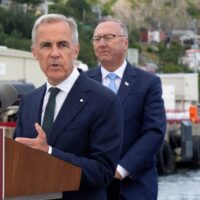
And together, both jurisdictions will reap the benefits of scale—vital for their shared goal of doubling the amount of electricity on their grids within a generation (by 2040 in Europe, by 2050 in Canada). A closer partnership means larger markets for clean technologies and co-ordination on critical minerals and supply chains in the face of Chinese market dominance. When Prime Minister Mark Carney described this historic moment as a “rupture” in his influential speech at Davos last year, he advised middle powers to respond by seeking solutions that rely not on “just the strength of our values, but also on the value of our strength.”
The EU and Canada, seeing the world through the same eyes, agree broadly on the strength of our shared values. Now it is time to share more closely the values of our many strengths—to pursue closer integration and co-operation, to counteract the aggressions of the major powers, and to build a cleaner, more resilient and more prosperous future together.