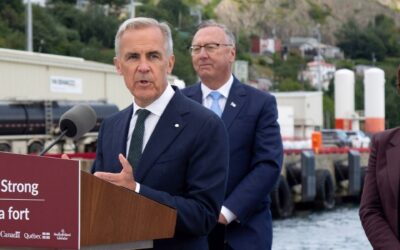

In the face of a global energy crisis and volatile oil prices, policy makers and commentators have begun comparing Canada’s future energy and decarbonization pathway to Norway’s. The parallels to Norway’s approach have become an increasingly common point of discussion, especially following Prime Minister Carney’s Forward Guidance video, which outlined a future for Canada where oil and gas exports grow while the domestic economy becomes increasingly electrified.
Norway is a global leader in electrification. For decades, Norwegians have shifted to electricity to heat their homes and fuel their cars. In 2023, 65 per cent of total final energy consumption by Norwegian industry came from electricity, 83 per cent of final consumption by households, and 75 per cent of final consumption by commercial and public services. By comparison, in Canada, electricity accounted for only 35 per cent of industrial energy use in 2023, 48 per cent of residential energy use, and 48 per cent of energy use by commercial and public services.
This divergence in electrification outcomes stands in contrast to the important structural similarities between the two countries in terms of climate, geography, and energy resources. For example, both Canada and Norway have access to large hydropower generation, providing abundant and relatively affordable clean electricity—a shared advantage for electrification. However, other similarities may be considered barriers to electrification, including the countries’ cold climates, their geographical size, and their oil and gas industries whose exports have been significant drivers of economic growth.
But while Norway used its hydropower advantage to become an electrification superpower, Canada is now waking up to the challenge. So how did Norway electrify its economy and can Canada become North America’s version of this Scandinavian success story?
This blog argues that Norway’s electrification leadership was neither an accident nor inevitable but the result of intentional, consistent policy choices by consecutive Norwegian governments over the past 50 years. It then suggests that Canada can follow Norway’s example by putting in place predictable, stable electrification policies to seize the benefits of large-scale electrification for Canadians.
The Norway approach: electrifying home heating
Electrifying home heating became a strategic priority for the Norwegian government in the early 1970s when the global energy crisis led to spiking oil prices. The goal was to increase Norway’s energy security and shield Norway’s economy and citizens from volatile global oil markets.
Norwegian governments implemented a diverse portfolio of policy instruments to boost heating electrification and, more recently, heat pump adoption. Policies included Norway’s carbon tax, introduced in 1991 and steadily increasing ever since; grants to pay for upfront costs of heat pumps; public information campaigns; and skills training for installers. With these policies establishing both demand and supply for heat pumps, Norway’s government introduced an outright ban on using fossil oils for heating buildings in 2018.
Importantly, these policies were not reversed as oil prices eased but remained stable across changing governments and decades.
Over time, heat pumps have replaced electric resistance heaters in Norwegian homes. Today, Norway has the highest penetration of heat pumps globally with more than two thirds of all households relying on the technology.
The Norway approach: electrifying transportation
Electric vehicle (EV) adoption is another outstanding success story in Norway’s electrification journey. In the first quarter of 2026, 98 per cent of all vehicles sold in Norway were battery electric. Roughly a third of all vehicles on the road in Norway are now electric. The country also has a well-established charging network, boasting the highest density of fast EV chargers in the world.
Similar to electric home heating, the high rates of EV adoption in Norway are the result of sustained, long-term policy interventions—including both political and financial commitments from Norwegian governments. Notably, in 1990, the government removed import taxes on zero emissions vehicles and over the following decade it introduced various perks for EV drivers, including free parking, free ferry rides, and reduced road tolls. As EV uptake reached a critical level, these supports have been phased out or reduced over time.
Other policies supporting EV uptake focus on boosting access to EV charging and building out an enabling electricity grid. Norwegians have the legislated right to charge in multi-unit buildings—a common challenge for EV drivers in other jurisdictions (including Canada). Norway’s grid was already developed to support residential heating when EV usage scaled up, but focused strategic investments in grid readiness may become necessary to support further growth.
Norway’s electrification is the result of strategic policy choices
The key insight emerging from these examples is that government policies—strategic and sustained—enabled Norway’s steep electrification trajectory. Diverse but stable policies were key to large-scale adoption of heat pumps and EVs and the associated systemic changes (e.g. charging infrastructure, workforce development). As a result of consistent policy incentives over decades, Norway has created path dependence in its electrification: economies of scale now make heat pumps and EVs the obvious economic choice for consumers. Over time, the government revised some policy supports that have now become unnecessary, as the market has matured for electrotech rendering them cost-competitive.
Norway’s electrification policies were, at least initially, not motivated by concerns over climate change but over energy security, economic resilience, and affordability. The country introduced electrification policies decades ago, at a time when the human causes of climate change were still largely unknown. Today, oil and gas exports are significant contributors to Norway’s economic prosperity, while its domestic economy is increasingly independent of fossil fuel consumption and therefore resilient to the recent shocks in global energy markets. The longstanding framing of electrification as a path toward economic security may have contributed to policy stability by avoiding the increasingly polarized political debates over key technologies like EVs and heat pumps seen in some other countries (for example, in Germany).
Canada’s lesson is that clear, stable policies amp up electrification
Ultimately, Canada cannot replicate the Norwegian model—after all, it is impossible to turn back time to the 1970s. But Canada can benefit from Norway’s early leadership: Norway’s early investment in electrification made Canada’s electrification journey easier by contributing to the heat pumps and EVs becoming cheaper and more efficient (for example, through long-standing research and development programs). Norway also serves as living proof for Canadians that these technologies work and can save households money—even in large countries with colder climates.
What Canadian governments should take away from Norway’s electrification example is the importance of policy-driven incentives. As the heat pump and EV examples show, Norway’s success was neither accidental nor inevitable but the result of targeted, sustained government actions. To be more like Norway, Canadian governments must set predictable, durable policy signals for electrification now. This will include implementing federal emissions regulations for cars that can credibly deliver on the declared target of 75 per cent EV sales by 2035 and 90 per cent by 2040—and then sticking with it. It also includes introducing smart policies that make it easier for all Canadian households to reap the benefits of EVs and heat pumps, including cost savings, better health, and greater comfort. Without a clear commitment that rivals the level of policy certainty Norway implemented over time, Canada will remain tethered to volatile fossil fuel markets for both its exports and its domestic economy for the foreseeable future.