
This article was previously published in the National Observer.
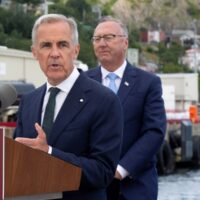
The federal government’s stated goal of doubling Canada’s electricity capacity in a generation received a major boost with the recent announcement of a $70-billion deal to work with the governments of Quebec and Newfoundland and Labrador to dramatically expand clean electricity in Labrador.
The deal includes significant new capacity at the existing Churchill Falls generating station, a new hydro project at Gull Island, new transmission lines, and huge amounts of new wind power in Labrador, to be developed in partnership with the Innu First Nation. This influx of clean electricity should enable the electrification and expansion of mining operations in the region, which also received federal financial support in last week’s announcement. The agreement aims to deliver massive amounts of new clean electricity—more than all the current power capacity overseen by BC Hydro—and promises to bring an end to many years of delay.
All in, it amounts to one of the largest electricity investments Canada has ever seen—and the biggest single bet yet on its clean-powered future. But as impressive as the size of this project might be, it now represents table stakes for governments across the country on the energy front in terms of the necessary scale of their ambitions. In aggregate, Canada needs not one but dozens of projects of this size, as quickly as they can be built. Not all provinces have a Churchill Falls to work with, but every government that takes electrification and climate action seriously should be looking for opportunities to build a portfolio that adds up to the same scale of opportunity, assembled from projects of every size.
As the federal government’s own electricity strategy recently confirmed, electrification will be the backbone of economic success for Canada in the years to come. And the strategy’s core commitment—doubling the size of the nation’s grids by 2050—is itself a commitment to lofty national ambition. Strong federal leadership will be essential to overcome interprovincial barriers and expand clean electricity capacity across the country, requiring unique federal powers of facilitation and funding. In the Churchill Falls agreement, the Carney government’s substantial financial support of up to $10 billion was instrumental in clearing some of the barriers that had been holding back this level of clean power investment.
Our recent research has shown that exactly this kind of targeted financial support is a powerful tool for accelerating the growth of cleaner, bigger grids that can attract large industrial users with low-cost electricity. It can also help keep rates affordable for all users as Canada expands its grids with clean power. For example, the federal loan guarantee provided for the development of Gull Island will lower the cost of capital, a saving that will be passed on to customers. Ultimately, the federal government alone has the ability to push past barriers to expanding grids between provinces and across regions, as well as the power of the purse to catalyze such projects at the necessary scale.
This agreement also illustrates the essential role of inter-governmental co-operation in building a wave of electrification across Canada. The projects vital to achieving this goal will be able to attract investment and earn the necessary approvals most efficiently and most cost-effectively through close collaboration across regions and at multiple orders of government, including Indigenous governments. The meaningful involvement of Indigenous communities in decision making will provide a particularly crucial test of the viability of new electricity projects. The Churchill Falls expansion itself is only an initial agreement, with more work required—especially with Innu communities—to make it a reality. Canada has a deep-rooted history of building energy projects on Indigenous lands without consent, causing long-lasting harms. Despite this unjust legacy, Indigenous communities across Canada have initiated projects and fought hard for inclusion, becoming the largest asset owners of clean energy in the country after the Crown and private utilities. These new projects on Indigenous lands in Labrador must establish Indigenous communities as rights holders, decision makers and co-owners as a necessary condition for success.
Getting these fundamentals right is crucial if new projects are to move forward at the pace Canada needs. Our research shows that for the first time in decades, provincial authorities are forecasting increases in electricity demand in the coming years, especially from large industrial users. But most do not have plans for sufficient growth to supply or distribute the power to meet that expected demand, despite rapidly falling costs of renewables and battery storage. That’s a big problem for Canada’s future clean growth. The Quebec-Labrador announcement should serve as a wake-up call—the best economic opportunities for new projects in high-growth sectors like critical minerals can only be seized by jurisdictions that recalibrate their plans to the necessary scale.
Churchill Falls is a major breakthrough for Quebec and Newfoundland and Labrador and a promising beginning to a new era of clean electricity in Canada. Government and electricity industry leaders alike must make a top priority of ensuring that the wave keeps building.