

In the lead-up to the Alberta-Canada MOU, we advised governments to implement a price floor—essentially a minimum credit price—in credit markets across Canada, including in Alberta. Doing so would address the fundamental problem in carbon markets: an oversupply of credits, leading to lower credit prices and lower expected future credit prices, which in turn undermines investment in projects and technologies that reduce greenhouse gas emissions.
The actual MOU, released earlier this year, did in fact establish a price floor—sort of. Unfortunately, Alberta is moving forward with a floor in a way that fails to address that root problem. In fact, the specific approach proposed exacerbates rather than addresses credit oversupply. Market data support this assertion, with TIER credits currently trading in the $32 dollar range, down about 25 per cent from before the MOU was finalized.
That’s obviously a bit confusing: how is the price floor being implemented different from the price floor we called for?
This blog provides an explainer on the economics of credit market dynamics under the MOU. The price floor we had proposed would dynamically address credit oversupply by requiring provinces to tighten credit markets in cases of oversupply. The proposed MOU price floor is de-linked from credit supply and demand, locking in oversupply, and undermining investment incentives.
The root cause: credit oversupply
Industrial carbon pricing markets in Canada, including Alberta’s Technology Innovation and Emissions Reduction (TIER) market, create a market for emissions credits by establishing emissions intensity performance standards for big emitters. Firms that perform better than their standard (i.e., have a lower emissions intensity) can generate credits. That’s the supply of credits in the markets. Firms that perform worse (i.e., have higher emissions intensity) have to buy credits or pay the government for their excess emissions. That’s the demand for credits in this market.
As we’ve shown, those market fundamentals are misaligned with the “headline” price of carbon (i.e., the originally planned $170 per tonne by 2030 aspiration). Actual market prices (and actual incentives to reduce emissions) have been lower than the headline price in Alberta, as well as in other markets.
Our proposed solution: addressing market fundamentals
As we proposed last year, governments could stabilize credit markets through some combination of tightening performance standards over time (i.e., increasing demand and decreasing supply), purchasing credits outright or holding some back (i.e., decreasing supply), or removing specific design features such as Alberta’s direct investment credit program that added additional credits without necessarily reducing emissions (i.e., decreasing supply).
Those solutions are best implemented at a provincial level for provincial markets, but the federal government, we proposed, could align provincial systems by tweaking its industrial carbon pricing benchmark, which establishes a minimum standard for provincial systems. That would give provinces the flexibility to choose how they deliver on a robust credit market without being prescriptive as to the means.
The market outcome would be a higher equilibrium credit price grounded in the underlying balance of supply and demand. The result would be a well-functioning market, with credit buyers and sellers each facing strong incentives to reduce emissions.
The MOU solution: regulating price instead of strengthening the market
The solution articulated by Alberta and the MOU, however, does something different; it effectively regulates the price of credits, imposing an administrative price set at the floor. In other words, any credits submitted for compliance legally must be at least at the minimum price defined in the MOU (a schedule rising to $110 per tonne in 2040). To be in compliance, a true-up is required to meet the compliance price floor. Think of this as the government artificially setting the price of credits rather than having it emerge from market supply and demand.
The effects of an administrative price floor are quite different from a price floor that aims to improve market fundamentals. Critically, under an administrative price floor, the credit market doesn’t clear: supply and demand don’t equilibrate and not all credits sell. That means that not all emitters will face the same incentives.
Emitters that are short (i.e., need additional credits to comply with the policy because their emissions exceed their performance standard) are indeed affected by the administrative price floor. Because they have to buy additional credits, they do so at the minimum price. And they will choose to reduce emissions if that’s a cheaper alternative.
Yet emitters that are long (i.e., have an excess of credits because they are relatively low-emissions) are different. They can’t sell credits at the price floor, because there is insufficient demand and an excess of supply. Firms will not buy credits for more than they are worth. Because the administrative price floor doesn’t change supply or demand, it simply reduces the number of transactions that clear through the market.
That’s a significant problem because emitters that are credit sellers are exactly the low-carbon projects and investments that the system is designed to attract. Low-carbon projects like renewable electricity projects, low-carbon chemical manufacturing, or carbon capture and storage projects depend on revenue from credit sales to be competitive and to attract investment. For these projects, the administrative price floor doesn’t help.
Worse, it’s increasingly clear that under the changes proposed in the MOU, most emitters are expected to be sellers, not buyers. That’s because the MOU locks in weak tightening rates (i.e., the rate at which performance standards become tighter over time). That will reduce compliance demand by 30 per cent in 2030 and 60 per cent in 2040 relative to policy design before the MOU. The net effect is a weak signal to invest in low-carbon projects.
A growing carbon credit glut over time
A figure can help illustrate the effects we describe above, but also illustrate how the administrative price floor actually exacerbates market dysfunction over time.
The figure below shows supply (red) and demand (blue) curves for credits. As the figure illustrates, the price floor (Pf) is well above the true value of credits (P*). At the price floor, Pf, supply and demand aren’t in equilibrium. Demand for credits is Qd. But the supply of credits is Qs. The excess of credits in the market (Qs-Qd) doesn’t get purchased: firms won’t buy credits at a higher price than they are worth to them. Instead, fewer credits will be sold on the market, with the excess banked.
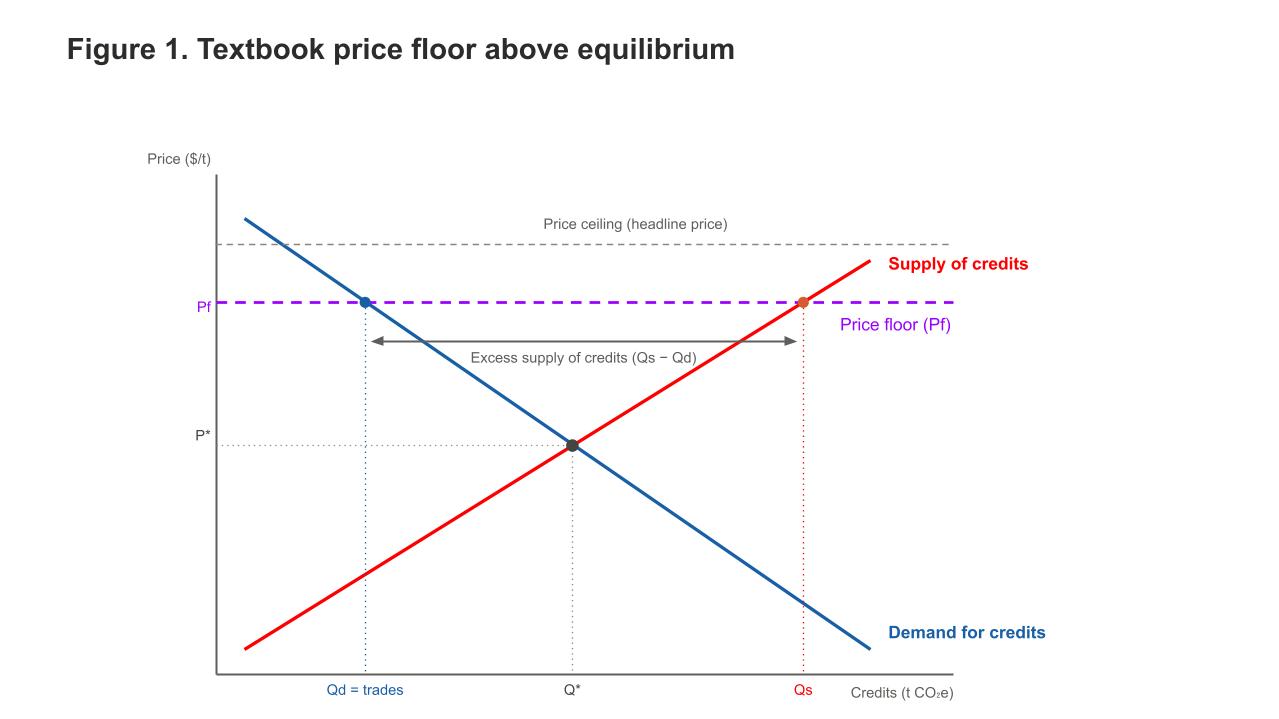
As the figure illustrates, an administrative price floor has some important implications.
First, it worsens liquidity of credit markets (i.e., the extent to which there’s sufficient buyers and sellers in a market to allow it to function and allow prices to emerge). Because many credits aren’t actually worth the price imposed by the price floor, fewer credits get traded; there are an insufficient number of buyers.
Second, it decreases transparency. The market is not in equilibrium, and price is no longer an indicator of market function because it has been artificially regulated. That is, the price of credits is a function of the floor, and (unlike in regular markets) doesn’t reflect credit supply (or oversupply). That makes it even harder for policymakers to determine whether the policy is working, and harder for investors to assess value of credits and expected revenues from credit sales.
Third, it creates incentives for gaming the market (as articulated well here by our academic friends Nic Rivers and Andrew Leach). Emitters will have incentives to avoid market transactions by bundling other products into credit trades or purchasing low-emitting facilities.
Finally—and most critically—the administrative price floor exacerbates the oversupply of credits over time, entrenching market dysfunction. Excess credits that can’t be sold (i.e., Qs-Qd in the figure) will simply be banked for future years. That banking, however, is unlikely to behave the way banking is typically designed to function. In a tightening market, firms bank credits because they anticipate higher future prices as scarcity increases. In a market with weak fundamentals, banking increasingly reflects excess supply rather than future value. With the regulated floor sitting above the market value credits, firms have little incentive to trade them.
The result is a market that increasingly struggles to perform its traditional functions: discovering prices, allocating credits efficiently, and signalling when new emissions reductions are needed.
In other words, an administrative floor makes an oversupply of credits self-reinforcing. Without stronger market fundamentals, excess credits continue to accumulate and prices increasingly depend on administrative rules (i.e., the price floor) rather than scarcity.
Compounding the problem, the floor fragments the market by vintage. That means credits representing the same tonne of emissions reduction no longer carry the same compliance value because that value depends on when they were originally issued. As the floor rises over time, the gap between market value and compliance value widens given increasing oversupply, making trading more difficult, encouraging larger credit banks, and further weakening the market’s ability to discover prices.
A real price floor requires fixing market fundamentals
The MOU leaves considerable flexibility as to how the price floor is implemented. Alberta should use that flexibility to strengthen market fundamentals to align with the minimum price agreed on in the MOU. That means restoring a credible path to increase scarcity through stronger benchmarks, reducing excess credit supply through credit purchases or other market-balancing mechanisms, and limiting direct investment credits that add to credit supply. It also means establishing strong governance practices to ensure transparency and enable course correction.
Overall, a well-designed floor should reinforce a functioning market, not substitute for one. Done well, it can create clear, transparent incentives to crowd-in private capital, rather than relying on governments to fund projects such as Pathways.