This article was previously published in the National Observer.
The first time a wildfire threatened my family, I wasn’t watching the flames.
I was listening to daily calls from my Mom.
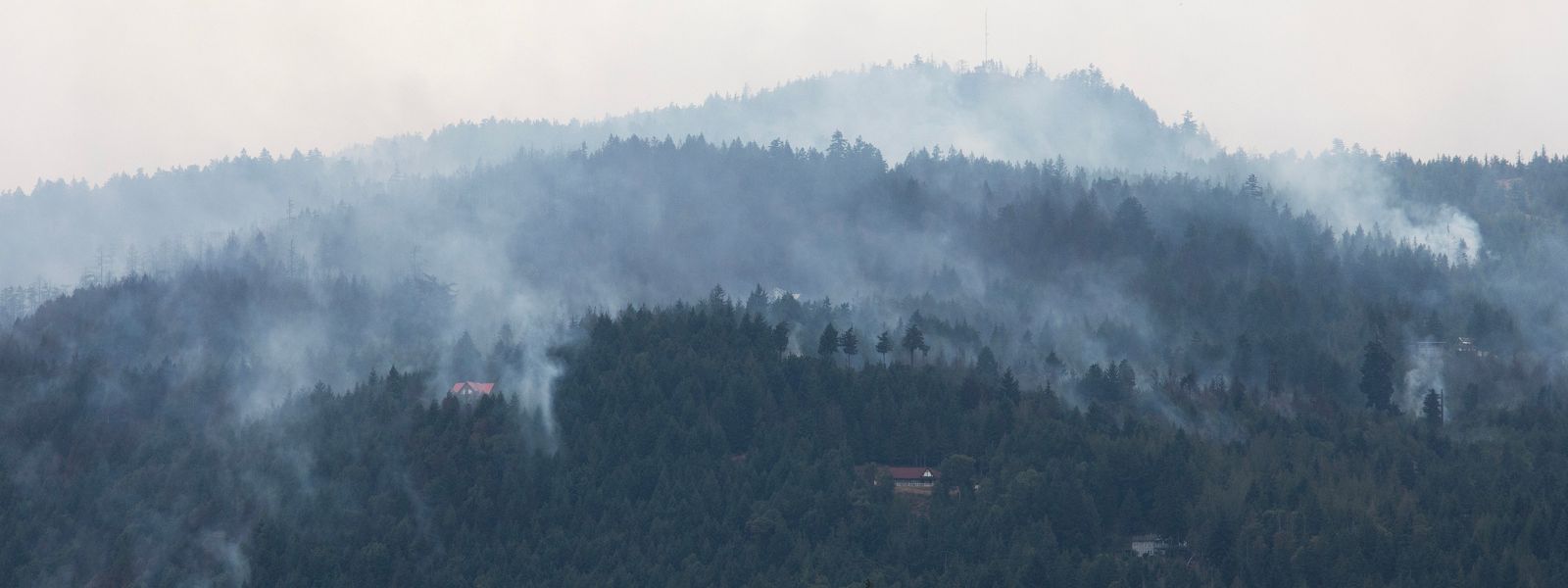
Ash settled across the barn, coated the vehicles, and drifted through the air like a snowfall. Every update from emergency officials in British Columbia tightened the knot in my stomach. But my greatest fear wasn’t whether my parents would lose their property.
It was whether my Mom could escape should she be alone.
She lived with Multiple Sclerosis and relied on a walker and, at times, a wheelchair. Access out of the house was limited. If an evacuation order came, every second would matter. Yet most emergency plans assume people can leave quickly and independently.
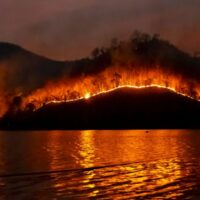
Last year, a wildfire burned just 13 kilometres from my own home. Ash rained onto the roof as the sky darkened until the sun became a deep orange orb suspended in smoke. Standing outside, I looked around my community—a municipality with a large retirement population—and realized I was asking the same question again.
Who gets left behind when climate disasters arrive?
Canada has entered an era that calls for urgently adapting to the impacts of our warming climate. It’s essential that governments invest in wildfire prevention and response, flood protection, emergency management, and resilient infrastructure.
But to be effective, adaptation plans should also address the assumption that everyone experiences disasters in the same way.
They don’t.
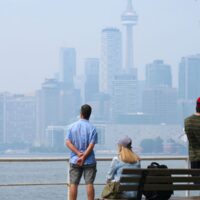
Climate change does not create inequity; it exposes and amplifies the inequities already built into our communities. During a wildfire, a person who relies on a wheelchair faces different barriers than someone who can flee on foot. During an extreme heat event, an older adult living alone experiences different risks than someone with air conditioning and a strong support network, or a worker who can’t miss a day because they will lose pay. Risks are compounded further for those with intersecting identities. For an Indigenous Elder living in a remote community, an evacuation may also mean leaving culturally significant places, navigating jurisdictional gaps, and losing access to trusted healthcare and community support.
These are not isolated stories. They are reminders that resilience is about more than infrastructure. It is about people.
Why accessibility should be central to climate resilience
Accessibility is often framed as something that benefits a minority of Canadians. Demographics tell a different story.
Canada is aging. Within the next decade, nearly one in four Canadians will be over the age of 65. Most of us, if we are fortunate enough to grow older, will experience changes in health like mobility, vision, hearing or cognition. Some disabilities are permanent. Others are temporary. All are part of the human experience.
In that sense, accessibility is not about someone else. It is about all of us.
We’ve seen this principle before. Curb cuts were designed for wheelchair users, yet parents pushing strollers, travellers pulling luggage, delivery workers, cyclists, and older adults all benefit from them. Automatic doors, captioning, and accessible websites make life easier for millions of people who never think of themselves as disabled.
Climate adaptation should work the same way.
When evacuation routes are accessible, they help older adults, parents with young children, people recovering from surgery, and anyone who needs more time to move. When emergency alerts are available in multiple formats, they reach more people. When cooling centres are accessible, communities become safer for everyone.
Designing for accessibility and reconciliation makes adaptation better for all
Designing for accessibility does not make adaptation less effective. It makes it more so—and saves lives.
The same principle applies to Indigenous rights.
Across Canada, governments are making important commitments to both reconciliation and accessibility, when developing climate adaptation strategies. Yet, while considering these factors together when developing plans and policies can improve outcomes, they are often viewed as separate and unrelated issues.
Climate adaptation cannot be truly equitable if it overlooks the rights, governance, and lived realities of First Nations, Inuit, and Métis communities. Nor can reconciliation be whole if climate policy fails to consider how disasters affect Indigenous Peoples disproportionately—including Indigenous people living with disabilities or chronic illnesses. Indigenous People are 30 times more likely to be affected by wildfires than non-Indigenous Canadians.
Both Indigenous rights and accessibility should not be considered as afterthoughts or viewed as competing priorities. They are both essential to building communities that can withstand a changing climate.
British Columbia offers a glimpse of what is possible. Through the Declaration on the Rights of Indigenous Peoples Act, the Accessible British Columbia Act, and its Climate Preparedness and Adaptation Strategy, the province has laid important foundations. The challenge now is to bring those commitments together rather than allowing them to remain separate initiatives.
These accommodations will come at a cost, but they will also save lives. When accessibility and reconciliation are treated from the start as integral to planning, rather than as add-ons, adaptation policy naturally shifts toward measures that work for everyone—from how buildings are designed to how self-determination is recognized and supported.
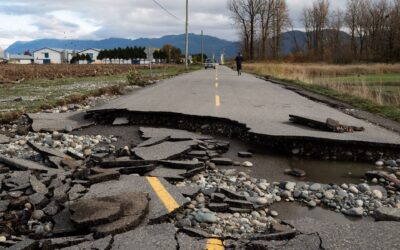
Climate adaptation is often measured by kilometres of dikes, hectares treated to reduce wildfire risk, or dollars invested in infrastructure.
Those are important measures, but perhaps we should also begin measuring who is being protected—and who isn’t. It’s a question that should consider who faces the greatest barriers to safety — including Indigenous Peoples confronting jurisdictional and historical inequities, and people with disabilities, as well as others like low-income households, newcomers, and people who are unhoused.
Can everyone evacuate safely? Can everyone access emergency information? Can everyone recover with dignity?
I often think back to the ash settling across my parents’ place while I lived far away. At the time, I believed the question was whether the fire would reach the house. Years later, I realize that was never the case.
The more important question was whether the systems surrounding us had imagined someone like my Mom when they were designed.
Climate change will test every community in Canada. The question is no longer whether we will adapt. It is: whose resilience are our policies designed to protect? If we build climate adaptation for those most likely to be left behind, we will build stronger, safer communities for everyone.